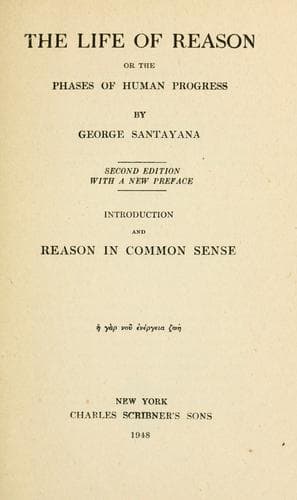
The Life of Reason: The Phases of Human ProgressSantayana, George
Philosophy
The Life of Reason: The Phases of Human Progress
Santayana, George
Philosophy
The feudal system offers perhaps the best illustration of a patriotism
wholly submerged in loyalty. The sense of mutual obligation and service
was very clear in this case; the vassal in swearing fealty knew
perfectly well what sort of a bargain he was striking. A feudal
government, while it lasted, was accordingly highly responsive and
responsible. If false to its calling, it could be readily disowned, for
it is easy to break an oath and to make new military associations,
especially where territorial units are small and their links accidental.
But this personal, conscious, and jealous subordination of man to man
constituted a government of insignificant scope. Military functions were
alone considered and the rest was allowed to shift for itself. Feudalism
could have been possible only in a barbarous age when the arts existed
on sufferance and lived on by little tentative resurrections. The feudal
lord was a genuine representative of a very small part of his vassal’s
interests. This slight bond sufficed, however, to give him a great
prestige and to stimulate in him all the habits and virtues of a
responsible master; so that in England, where vestiges of feudalism
abound to this day, there is an aristocracy not merely titular.
[Sidenote: Monarchical representation comprehensive but treacherous.]
A highly concentrated monarchy presents the exactly opposite phenomenon.
Here subordination is involuntary and mutual responsibility largely
unconscious. On the other hand, the scope of representation is very wide
and the monarch may well embody the whole life of the nation. A great
court, with officers of state and a standing army, is sensitive to
nothing so much as to general appearances and general results. The
invisible forces of industry, morality, and personal ambition that
really sustain the state are not studied or fomented by such a
government; so that when these resources begin to fail, the ensuing
catastrophes are a mystery to everybody. The king and his ministers
never cease wondering how they can be so constantly unfortunate.
Public-domain text, read in full here on John Shaqi.
Reviews
Reviews
No reviews yet
Be the first to share your thoughts on this work.
Elsewhere in the archive
Join the Discussion
Join the discussion
Sign in to leave a comment or review.
Sign InorCreate an account