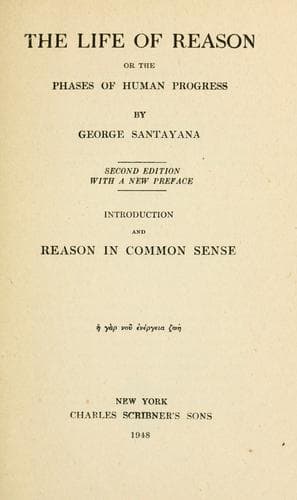
The Life of Reason: The Phases of Human ProgressSantayana, George
Philosophy
The Life of Reason: The Phases of Human Progress
Santayana, George
Philosophy
So long, however, as the nation’s vital force is unspent and taxes and
soldiers are available in plenty, a great monarchy tends to turn those
resources to notable results. The arts and sciences are encouraged by
the patronage of men of breeding and affairs; they are disciplined into
a certain firmness and amplitude which artists and scholars, if left to
themselves, are commonly incapable of. Life is refined; religion itself,
unless fanaticism be too hopelessly in the ascendant, is co-ordinated
with other public interests and compelled to serve mankind; a liberal
life is made possible; the imagination is stimulated and set free by
that same brilliant concentration of all human energies which defeats
practical liberty. At the same time luxury and all manner of conceits
are part and parcel of such a courtly civilisation, and its best
products are the first to be lost; so that very likely the dumb forces
of society—hunger, conscience, and malice—will not do any great harm
when they destroy those treacherous institutions which, after giving the
spirit a momentary expression, had become an offence to both spirit and
flesh. Observers at the time may lament the collapse of so much
elegance and greatness; but nature has no memory and brushes away
without a qualm her card-castle of yesterday, if a new constructive
impulse possesses her to-day.
[Sidenote: Impersonal symbols no advantage.]
Where no suitable persons are found to embody the state’s unity, other
symbols have to be chosen. Besides the gods and their temples, there are
the laws which may, as among the Jews and Mohammedans, become as much a
fetich as any monarch, and one more long-lived; or else some traditional
policy of revenge or conquest, or even the country’s name or flag, may
serve this symbolic purpose. A trivial emblem, which no thinking man can
substitute for the thing signified, is not so great an advantage as at
first sight it might seem; for in the first place men are often
thoughtless and adore words and symbols with a terrible earnestness;
while, on the other hand, an abstract token, because of its natural
insipidity, can be made to stand for anything; so that patriotism, when
it uses pompous words alone for its stimulus, is very apt to be a cloak
for private interests, which the speaker may sincerely conceive to be
the only interests in question.
[Sidenote: Patriotism not self-interest, save to the social man whose
aims are ideal.]
Public-domain text, read in full here on John Shaqi.
Reviews
Reviews
No reviews yet
Be the first to share your thoughts on this work.
Elsewhere in the archive
Join the Discussion
Join the discussion
Sign in to leave a comment or review.
Sign InorCreate an account