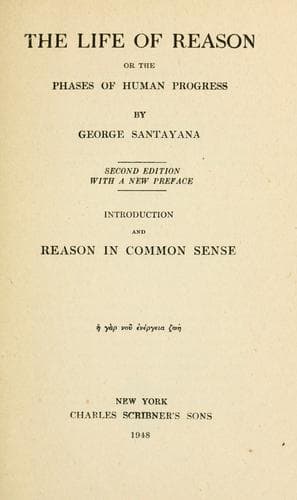
The Life of Reason: The Phases of Human ProgressSantayana, George
Philosophy
The Life of Reason: The Phases of Human Progress
Santayana, George
Philosophy
It is see how a moral world can grow out of these primary intuitions.
Knowing, for instance, the expression of anger, a man may come to find
anger directed against himself; together with physical fear in the
presence of attack, he will feel the contagion of his enemy’s passion,
especially if his enemy be the whole group whose reactions he is wont to
share, and something in him will strive to be angry together with the
rest of the world. He will perfectly understand that indignation against
himself which in fact he instinctively shares. This self-condemning
emotion will be his sense of shame and his conscience. Words soon come
to give definition to such a feeling, which without expression in
language would have but little stability. For when a man is attracted to
an act, even if it be condemned by others, he views it as delightful and
eligible in itself; but when he is forced, by the conventional use of
words, to attach to that act an opprobrious epithet, an epithet which he
himself has always applied with scorn, he finds himself unable to
suppress the emotion connoted by the word; he cannot defend his
rebellious intuition against the tyranny of language; he is inwardly
confused and divided against himself, and out of his own mouth convicted
of wickedness.
A proof of the notable influence that language has on these emotions may
be found in their transformations. The connivance of a very few persons
is sufficient to establish among them a new application of eulogistic
terms; it will suffice to suppress all qualms in the pursuance of their
common impulse and to consecrate a new ideal of character. It is
accordingly no paradox that there should be honour among thieves,
kindness among harlots, and probity among fanatics. They have not lost
their conscience; they have merely introduced a flattering heresy into
the conventional code, to make room for the particular passion indulged
in their little world.
[Sidenote: Guises of public opinion.]
Public-domain text, read in full here on John Shaqi.
Reviews
Reviews
No reviews yet
Be the first to share your thoughts on this work.
Elsewhere in the archive
Join the Discussion
Join the discussion
Sign in to leave a comment or review.
Sign InorCreate an account