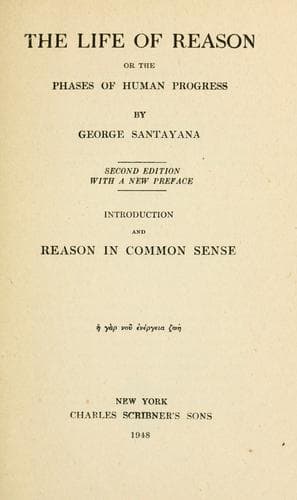
The Life of Reason: The Phases of Human ProgressSantayana, George
Philosophy
The Life of Reason: The Phases of Human Progress
Santayana, George
Philosophy
Sympathy with the general mind may also take other forms. Public
opinion, in a vivacious and clear-headed community, may be felt to be
the casual and irresponsible thing which in truth it is. Homer, for
instance, has no more solemn vehicle for it than the indefinite and
unaccountable [Greek: tis]. “So,” he tells us, “somebody or anybody
said.” In the Greek tragedians this unauthoritative entity was replaced
by the chorus, an assemblage of conventional persons, incapable of any
original perception, but possessing a fund of traditional lore, a just
if somewhat encumbered conscience, and the gift of song. This chorus was
therefore much like the Christian Church and like that celestial choir
of which the church wishes to be the earthly echo. Like the church, the
tragic chorus had authority, because it represented a wide, if
ill-digested, experience; and it had solemnity, because it spoke in
archaic tropes, emotional and obscure symbols of prehistoric conflicts.
These sacramental forms retained their power to move in spite of their
little pertinence to living issues, partly on account of the mystery
which enshrouded their forgotten passion and partly on account of the
fantastic interpretations which that pregnant obscurity allowed.
[Sidenote: Oracles and revelations.]
Far more powerful, however, are those embodiments of the general
conscience which religion furnishes in its first and spontaneous phase,
as when the Hebrew prophets dared to cry, “So saith the Lord.” Such
faith in one’s own inspiration is a more pliable oracle than tradition
or a tragic chorus, and more responsive to the needs and changes of the
hour. Occidental philosophers, in their less simple and less eloquent
manner, have often repeated that arrogant Hebraic cry: they have told us
in their systems what God thinks about the world. Such pretensions would
be surprising did we not remind ourselves of the obvious truth that what
men attribute to God is nothing but the ideal they value and grope for
in themselves, and that the commandments, mythically said to come from
the Most High, flow in fact from common reason and local experience.
Public-domain text, read in full here on John Shaqi.
Reviews
Reviews
No reviews yet
Be the first to share your thoughts on this work.
Elsewhere in the archive
Join the Discussion
Join the discussion
Sign in to leave a comment or review.
Sign InorCreate an account