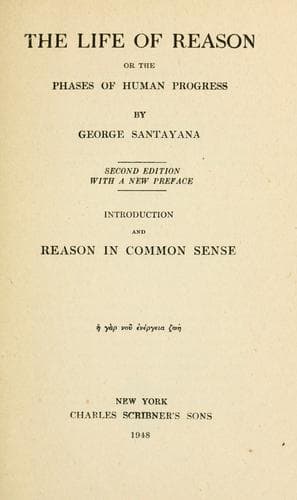
The Life of Reason: The Phases of Human ProgressSantayana, George
Philosophy
The Life of Reason: The Phases of Human Progress
Santayana, George
Philosophy
Those ideal objects, however, for whose sake all revolutions in space
and time may be followed with interest, are not themselves members of
our society. The ideal to which all forces should minister is itself no
force or factor in its own realisation. Such a possible disposition of
things is a mere idea, eternal and inert, a form life might possibly
take on and the one our endeavours, if they were consistent, would wish
to impose on it. This ideal itself, however, has often been expressed in
some mythical figure or Utopia. So to express it is simply to indulge an
innocent instinct for prophecy and metaphor; but unfortunately the very
innocence of fancy may engage it all the more hopelessly in a tangle of
bad dreams. If we once identify our Utopia or other ideal with the real
forces that surround us, or with any one of them, we have fallen into an
illusion from which we shall emerge only after bitter disappointments;
and even when we have come out again into the open, we shall long carry
with us the desolating sense of wasted opportunities and vitiated
characters. For to have taken our purposes for our helpers is to have
defeated the first and ignored the second; it is to have neglected
rational labour and at the same time debauched social sense.
The religious extensions of society should therefore be carefully
watched; for while sometimes, as with the Hebrew prophets, religion
gives dramatic expression to actual social forces and helps to intensify
moral feeling, it often, as in mystics of all creeds and ages, deadens
the consciousness of real ties by feigning ties which are purely
imaginary. This self-deception is the more frequent because there float
before men who live in the spirit ideals which they look to with the
respect naturally rendered to whatever is true, beautiful, or good; and
the symbolic rendering of these ideals, which is the rational function
of religion, may be confused with its superstitious or utilitarian
part—with exploiting occult forces to aid us in the work of life.
Public-domain text, read in full here on John Shaqi.
Reviews
Reviews
No reviews yet
Be the first to share your thoughts on this work.
Elsewhere in the archive
Join the Discussion
Join the discussion
Sign in to leave a comment or review.
Sign InorCreate an account