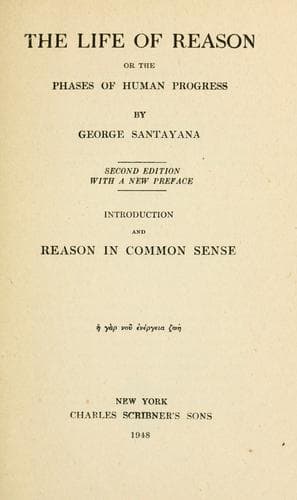
The Life of Reason: The Phases of Human ProgressSantayana, George
Philosophy
The Life of Reason: The Phases of Human Progress
Santayana, George
Philosophy
Occult forces may indeed exist, and they may even be so disposed that
the ideal is served by their agency; but the most notable embodiment of
a principle is not itself a principle, being only an instance, and the
most exact fulfilment of a law is not a law, being simply an event. To
discover a law may meantime be the most interesting of events, and the
image or formula that expresses a principle may be the most welcome of
intellectual presences. These symbols, weighted with their wide
significance, may hold the mind and attract its energies into their
vortex; and human genius is certainly not at its worst when employed in
framing a good myth or a good argument. The lover of representation, be
he thinker or dramatist, moves by preference in an ideal society. His
communion with the world is half a soliloquy, for the personages in his
dialogue are private symbols, and being symbols they stand for what is
not themselves; the language he imputes to them is his own, though it
is their ways that prompt him to impute that language to them. Plastic
images of his own making and shifting are his sole means of envisaging
eternal principles and ultimate substances, things ideal and potential,
which can never become phenomenal in their own persons.
[Sidenote: Contrast between natural and intellectual bonds.]
It is an inspiring thought, and a true one, that in proportion as a
man’s interests become humane and his efforts rational, he appropriates
and expands a common life, which reappears in all individuals who reach
the same impersonal level of ideas—a level which his own influence may
help them to maintain. Patriotism envisages this ideal life in so far as
it is locally coloured and grounded in certain racial aptitudes and
traditions; but the community recognised in patriotism is imbedded in a
larger one embracing all living creatures. While in some respects we
find sympathy more complete the nearer home we remain, in another sense
there is no true companionship except with the universe. Instinctive
society, with its compulsory affections, is of course deeper and more
elementary than any free or intellectual union. Love is at once more
animal than friendship and more divine; and the same thing may be said
of family affection when compared with patriotism. What lies nearer the
roots of our being must needs enjoy a wider prevalence and engage the
soul more completely, being able to touch its depths and hush its
primordial murmurs.
Public-domain text, read in full here on John Shaqi.
Reviews
Reviews
No reviews yet
Be the first to share your thoughts on this work.
Elsewhere in the archive
Join the Discussion
Join the discussion
Sign in to leave a comment or review.
Sign InorCreate an account