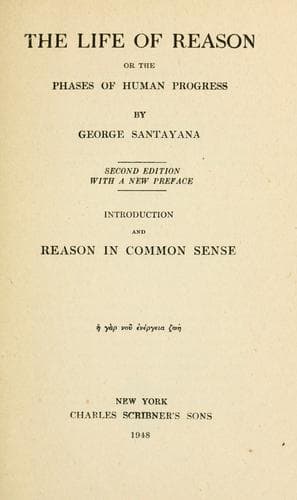
The Life of Reason: The Phases of Human ProgressSantayana, George
Philosophy
The Life of Reason: The Phases of Human Progress
Santayana, George
Philosophy
In religion and science the overt purpose of symbols is to represent
external truths. The inventors of these symbols think they are merely
uncovering a self-existent reality, having in itself the very form seen
in their idea. They do not perceive that the society of God or Nature
is an ideal society, nor that these phantoms, looming in their
imagination, are but significant figments whose existent basis is a
minute and indefinite series of ordinary perceptions. They consequently
attribute whatever value their genial syntheses may have to the object
as they picture it. The gods have, they fancy, the aspect and passions,
the history and influence which their myth unfolds; nature in its turn
contains hypostatically just those laws and forces which are described
by theory. Consequently the presence of God or Nature seems to the
mythologist not an ideal, but a real and mutual society, as if
collateral beings, endowed with the conceived characters, actually
existed as men exist. But this opinion is untenable. As Hobbes said, in
a phrase which ought to be inscribed in golden letters over the head of
every talking philosopher: _No discourse whatsoever can end in absolute
knowledge of fact_. Absolute knowledge of fact is immediate, it is
experiential. We should have to _become_ God or Nature in order to know
for a fact that they existed. Intellectual knowledge, on the other hand,
where it relates to existence, is faith only, a faith which in these
matters means trust. For the forces of Nature or the gods, if they had
crude existence, so that we might conceivably become what they are,
would lose that causal and that religious function which are their
essence respectively. They would be merely collateral existences, loaded
with all sorts of irrelevant properties, parts of the universal flux,
members of a natural society; and while as such they would have their
relative importance, they would be embraced in turn within an
intelligible system of relations, while their rights and dignities would
need to be determined by some supervening ideal. A nature existing in
act would require metaphysics—the account of a deeper nature—to
express its relation to the mind that knew and judged it. Any actual god
would need to possess a religion of his own, in order to fix his ideal
of conduct and his rights in respect to his creatures or rather, as we
should then be, to his neighbours. This situation may have no terrors
for the thoughtless; but it evidently introduces something deeper than
Nature and something higher than God, depriving these words of the best
sense in which a philosopher might care to use them.
[Sidenote: Their opposite outlook.]
Public-domain text, read in full here on John Shaqi.
Reviews
Reviews
No reviews yet
Be the first to share your thoughts on this work.
Elsewhere in the archive
Join the Discussion
Join the discussion
Sign in to leave a comment or review.
Sign InorCreate an account