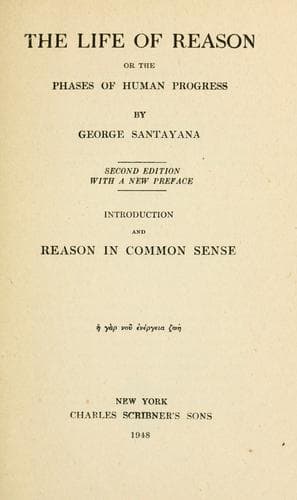
The Life of Reason: The Phases of Human ProgressSantayana, George
Philosophy
The Life of Reason: The Phases of Human Progress
Santayana, George
Philosophy
Ideal society belongs entirely to this realm of kindly illusion, for it
is the society of symbols. Whenever religion, art, or science presents
us with an image or a formula, involving no matter how momentous a
truth, there is something delusive in the representation. It needs
translation into the detailed experience which it sums up in our own
past or prophecies elsewhere. This eventual change in form, far from
nullifying our knowledge, can alone legitimise it. A conception not
reducible to the small change of daily experience is like a currency not
exchangeable for articles of consumption; it is not a symbol, but a
fraud. And yet there is another aspect to the matter. Symbols are
presences, and they are those particularly congenial presences which we
have inwardly evoked and cast in a form intelligible and familiar to
human thinking. Their function is to give flat experience a rational
perspective, translating the general flux into stable objects and making
it representable in human discourse. They are therefore precious, not
only for their representative or practical value, implying useful
adjustments to the environing world, but even more, sometimes, for their
immediate or æsthetic power, for their kinship to the spirit they
enlighten and exercise.
This is prevailingly true in the fine arts which seem to express man
even more than they express nature; although in art also the symbol
would lose all its significance and much of its inward articulation if
natural objects and eventual experience could be disregarded in
constructing it. In music, indeed, this ulterior significance is reduced
to a minimum; yet it persists, since music brings an ideal object before
the mind which needs, to some extent, translation into terms no longer
musical—terms, for instance, of skill, dramatic passion, or moral
sentiment. But in music pre-eminently, and very largely in all the arts,
external propriety is adventitious; so much can the mere presence and
weight of a symbol fill the mind and constitute an absolute possession.
[Sidenote: Religion and science indirectly cognitive and directly
ideal.]
Public-domain text, read in full here on John Shaqi.
Reviews
Reviews
No reviews yet
Be the first to share your thoughts on this work.
Elsewhere in the archive
Join the Discussion
Join the discussion
Sign in to leave a comment or review.
Sign InorCreate an account