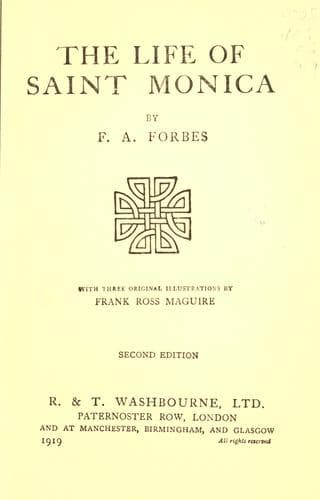
The Life of Saint MonicaForbes, F. A. (Frances Alice)
History
The Life of Saint Monica
Forbes, F. A. (Frances Alice)
Monica, Saint, -387
On the sunny northern coast of Africa in the country which we now
call Algeria stood, in the early days of Christianity, a city called
Tagaste. Not far distant lay the field of Zarna, where the glory of
Hannibal had perished for ever. But Rome had long since avenged the
sufferings of her bitter struggle with Carthage. It was the ambition
of Roman Africa, as the new colony had been called by its conquerors,
to be, if possible, more Roman than Rome. Every town had its baths,
its theatre, its circus, its temples, its aqueducts. It was forbidden
even to exiles as a place of refuge--too much like home, said the
authorities.
It was about the middle of the fourth century. The Church was coming
forth from her long imprisonment into the light of day. The successor
of Constantine, in name a Christian, sat on the Imperial throne. The
old struggle with paganism, which had lasted for four hundred years,
was nearly at an end, but new dangers assailed the Christian world.
Men had found that it was easier to twist the truth than to deny it,
and heresy and schism were abroad.
In the atrium or outer court of a villa on the outskirts of Tagaste
an old woman and a young girl sat together looking out into the dark
shadows of the evening, for the hot African sun had sunk not long
since behind the Numidian Mountains, and the day had gone out like a
lamp.
"And the holy Bishop Cyprian?" asked the girl.
"They sent him into exile," said the old woman, "for his father had
been a Senator, and his family was well known and powerful. At that
time they dared not put him to death, though later he, too, shed his
blood for Christ. It was God's will that he should remain for many
years to strengthen his flock in the trial."
"Did you ever see him, grandmother?" asked the girl.
"No," said the old woman, "it was before my time; but my mother knew
him well. It was when he was a boy in Carthage and still a pagan that
the holy martyrs Perpetua and Felicitas suffered with their
companions. It was not till years after that he became a Christian,
but it may have been their death that sowed the first seed in his
heart."
"Tell me," said the girl softly. It was an oft-told tale of which she
never tired. Her grandmother had lived through those dark days of
persecution, and it was the delight of Monica's girlhood to hear her
tell the stories of those who had borne witness to the Faith in their
own land of Africa.
"Perpetua was not much older than you," said the old woman. "She was
of noble race and born of a Christian mother, though her father was a
pagan. She was married, and had a little infant of a few months' old.
When she was called before the tribunal of Hilarion the Roman
Governor, all were touched by her youth and beauty. Sacrifice to the
gods,' they said, 'and you shall go free.' 'I am a Christian,' she
answered, and nothing more would she say, press her as they might.
Public-domain text, read in full here on John Shaqi.
Reviews
Reviews
No reviews yet
Be the first to share your thoughts on this work.
Join the Discussion
Join the discussion
Sign in to leave a comment or review.
Sign InorCreate an account