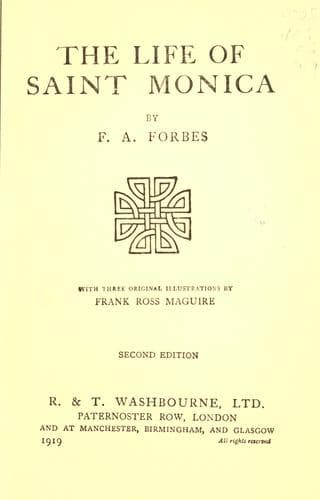
The Life of Saint MonicaForbes, F. A. (Frances Alice)
History
The Life of Saint Monica
Forbes, F. A. (Frances Alice)
Monica, Saint, -387
Patricius, who loved his young wife with the only kind of love of
which he was capable, had nothing in common with her, and had no clue
to her thoughts or actions. He had neither reverence nor respect for
women--indeed, most of the women of his acquaintance were deserving
of neither--and he had chosen Monica for her beauty, much as he would
have chosen a horse or a dog. He thought her ways and ideas
extraordinary. She took as kindly an interest in the slaves as if
they had been of her own flesh and blood, and would even intercede to
spare them a beating. She liked the poor, and would gather these
dirty and unpleasant people about her, going so far even as to wash
and dress their sores. Patricius did not share her attraction, and
objected strongly to such proceedings; but Monica pleaded so humbly
and sweetly that he gave way, and let her do what seemed to cause her
so much pleasure. "There was no accounting for tastes," he remarked.
She would spend hours in the church praying, with her great eyes
fixed on the altar. True, she was never there at any time when she
was likely to be missed by her husband, and never was she so full of
tender affection for him as when she came home; but still, it was a
strange way of spending one's time.
There was something about Monica, it is true, that was altogether
unlike any other inmate of the house, as she went about her daily
duties, always watching for the chance of doing a kind action.
When Patricius was in one of his violent tempers, shouting, abusing,
and even striking everybody who came in his way, she would look at
him with gentle eyes that showed neither fear nor anger. She never
answered sharply, even though his rude words wounded her cruelly. He
had once raised his hand to strike her, but he had not dared;
something--he did not know what--withheld him.
Later, when his anger had subsided, and he was perhaps a little
ashamed of his violence, she would meet him with an affectionate
smile, forgiving and forgetting all. Only if he spoke himself, and,
touched at her generous forbearance, tried shamefacedly to make
amends for his treatment of her, would she gently explain her
conduct. More often she said nothing, knowing that actions speak more
loudly than words. As her greatest biographer says of her: "She spoke
little, preached not at all, loved much, and prayed unceasingly."
Public-domain text, read in full here on John Shaqi.
Reviews
Reviews
No reviews yet
Be the first to share your thoughts on this work.
Join the Discussion
Join the discussion
Sign in to leave a comment or review.
Sign InorCreate an account