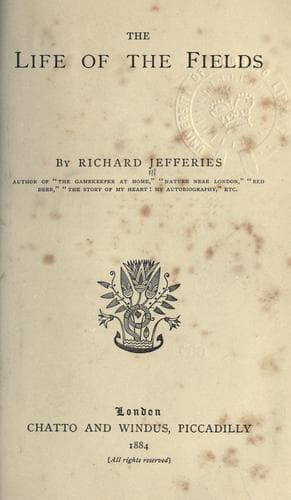
Natural history -- Outdoor books; Nature; Nature study; Paris (France) -- Description and travel
only a proof that he is keeping his balance.
The kestrel is not the only bird that hovers. The sparrowhawk can. So
can all the finches, more or less, when taking seeds from a plant which
will not bear their weight or which they cannot otherwise get at; also
when taking insects on the wing. Sparrows do the same. Larks hover in
their mating season uttering a short song, not the same as when they
soar. Numerous insects can hover: the great dragon-fly will stop dead
short in his rapid flight, and stay suspended till it suits him to
advance. None of these require any current or wind. I do not think that
hovering requires so much strength of wing or such an exercise of force
as when birds rise almost straight up. Snipes do it, and woodcocks; so
also pheasants, rocketing with tremendous effort; so also a sparrow in
a confined court, rising almost straight to the slates. Evidently this
needs great power. Hovering is very interesting; but not nearly so
mysterious as at least one other power possessed by birds.
BIRDS CLIMBING THE AIR
Two hawks come over the trees, and, approaching each other, rise higher
into the air. They wheel about for a little without any apparent
design, still rising, when one ceases to beat the air with his wings,
stretches them to their full length, and seems to lean aside. His
impetus carries him forward and upward, at the same time in a circle,
something like a skater on one foot. Revolving round a centre, he rises
in a spiral, perhaps a hundred yards across; screwing upwards, and at
each turn ascending half the diameter of the spiral. When he begins
this it appears perfectly natural, and nothing more than would
necessarily result if the wings were held outstretched and one edge of
the plane slightly elevated. The impulse of previous flight, the beat
of strong pinions, and the swing and rush of the bird evidently suffice
for two or three, possibly for four or five, winding movements, after
which the retarding effects of friction and gravitation ought,
according to theory, to gradually bring the bird to a stop. But up goes
the hawk, round and round like a woodpecker climbing a tree; only the
hawk has nothing tangible into which to stick his claws and to rest his
tail against. Those winding circles must surely cease; his own weight
alone must stop him, and those wide wings outstretched must check his
course. Instead of which the hawk rises as easily as at first, and
without the slightest effort--no beat of wing or flutter, without even
a slip or jerk, easily round and round. His companion does the same;
often, perhaps always, revolving the opposite way, so as to face the
first. It is a fascinating motion to watch.
Public-domain text, read in full here on John Shaqi.
Reviews
Reviews
No reviews yet
Be the first to share your thoughts on this work.
Elsewhere in the archive
Join the Discussion
Join the discussion
Sign in to leave a comment or review.
Sign InorCreate an account