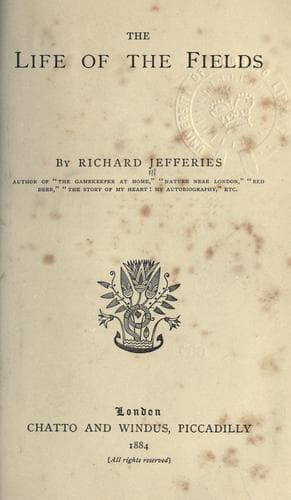
Natural history -- Outdoor books; Nature; Nature study; Paris (France) -- Description and travel
It is the patient humble-bee that goes down into the forest of the
mowing-grass. If entangled, the humble-bee climbs up a sorrel stem and
takes wing, without any sign of annoyance. His broad back with tawny
bar buoyantly glides over the golden buttercups. He hums to himself as
he goes, so happy is he. He knows no skep, no cunning work in glass
receives his labour, no artificial saccharine aids him when the beams
of the sun are cold, there is no step to his house that he may alight
in comfort; the way is not made clear for him that he may start
straight for the flowers, nor are any sown for him. He has no shelter
if the storm descends suddenly; he has no dome of twisted straw well
thatched and tiled to retreat to. The butcher-bird, with a beak like a
crooked iron nail, drives him to the ground, and leaves him pierced
with a thorn; but no hail of shot revenges his tortures. The grass
stiffens at nightfall (in autumn), and he must creep where he may, if
possibly he may escape the frost. No one cares for the humble-bee. But
down to the flowering nettle in the mossy-sided ditch, up into the tall
elm, winding in and out and round the branched buttercups, along the
banks of the brook, far inside the deepest wood, away he wanders and
despises nothing. His nest is under the rough grasses and the mosses of
the mound; a mere tunnel beneath the fibres and matted surface. The
hawthorn overhangs it, the fern grows by, red mice rustle past.
It thunders, and the great oak trembles; the heavy rain drops through
the treble roof of oak and hawthorn and fern. Under the arched branches
the lightning plays along, swiftly to and fro, or seems to, like the
swish of a whip, a yellowish-red against the green; a boom! a crackle
as if a tree fell from the sky. The thick grasses are bowed, the white
florets of the wild parsley are beaten down, the rain hurls itself, and
suddenly a fierce blast tears the green oak leaves and whirls them out
into the fields; but the humble-bee's home, under moss and matted
fibres, remains uninjured. His house at the root of the king of trees,
like a cave in the rock, is safe. The storm passes and the sun comes
out, the air is the sweeter and the richer for the rain, like verses
with a rhyme; there will be more honey in the flowers. Humble he is,
but wild; always in the field, the wood; always by the banks and
thickets; always wild and humming to his flowers. Therefore I like the
humble-bee, being, at heart at least, for ever roaming among the
woodlands and the hills and by the brooks. In such quick summer storms
the lightning gives the impression of being far more dangerous than the
zigzag paths traced on the autumn sky. The electric cloud seems almost
level with the ground and the livid flame to rush to and fro beneath
the boughs as the little bats do in the evening.
Public-domain text, read in full here on John Shaqi.
Reviews
Reviews
No reviews yet
Be the first to share your thoughts on this work.
Join the Discussion
Join the discussion
Sign in to leave a comment or review.
Sign InorCreate an account