The Life of the Fly; With Which are Interspersed Some Chapters of Autobiography — John Shaqi
The Life of the Fly; With Which are Interspersed Some Chapters of AutobiographyFabre, Jean-Henri
Science
The Life of the Fly; With Which are Interspersed Some Chapters of Autobiography
Fabre, Jean-Henri
Diptera; Flies
And then, my dear insects, if you cannot convince those good people,
because you do not carry the weight of tedium, I, in my turn, will say
to them: 'You rip up the animal and I study it alive; you turn it into
an object of horror and pity, whereas I cause it to be loved; you labor
in a torture chamber and dissecting room, I make my observations under
the blue sky to the song of the cicadas, you subject cell and protoplasm
to chemical tests, I study instinct in its loftiest manifestations;
you pry into death, I pry into life. And why should I not complete
my thought: the boars have muddied the clear stream; natural history,
youth's glorious study, has, by dint of cellular improvements, become a
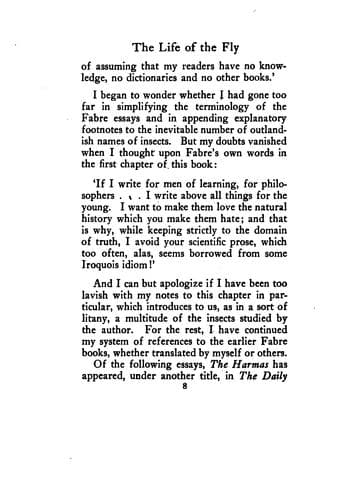
hateful and repulsive thing. Well, if I write for men of learning, for
philosophers, who, one day, will try to some extent to unravel the tough
problem of instinct, I write also, I write above all things for the
young. I want to make them love the natural history which you make them
hate; and that is why, while keeping strictly to the domain of truth, I
avoid your scientific prose, which too often, alas seems borrowed from
some Iroquois idiom.
But this is not my business for the moment: I want to speak of the
bit of land long cherished in my plans to form a laboratory of living
entomology, the bit of land which I have at last obtained in the
solitude of a little village. It is a harmas, the name given, in this
district [the country round Serignan, in Provence], to an untilled,
pebbly expanse abandoned to the vegetation of the thyme. It is too poor
to repay the work of the plow; but the sheep passes there in spring,
when it has chanced to rain and a little grass shoots up.
My harmas, however, because of its modicum of red earth swamped by a
huge mass of stones, has received a rough first attempt at cultivation:
I am told that vines once grew here. And, in fact, when we dig the
ground before planting a few trees, we turn up, here and there, remains
of the precious stock, half carbonized by time. The three pronged fork,
therefore, the only implement of husbandry that can penetrate such
a soil as this, has entered here; and I am sorry, for the primitive
vegetation has disappeared. No more thyme, no more lavender, no more
clumps of kermes oak, the dwarf oak that forms forests across which we
step by lengthening our stride a little. As these plants, especially the
first two, might be of use to me by offering the Bees and Wasps a spoil
to forage, I am compelled to reinstate them in the ground whence they
were driven by the fork.
Public-domain text, read in full here on John Shaqi.
Reviews
Reviews
No reviews yet
Be the first to share your thoughts on this work.
Join the Discussion
Join the discussion
Sign in to leave a comment or review.
Sign InorCreate an account