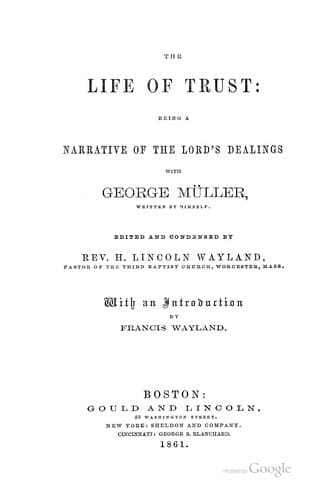
The Life of Trust: Being a Narrative of the Lord's Dealings With George MüllerMüller, George
Religion
The Life of Trust: Being a Narrative of the Lord's Dealings With George Müller
Müller, George
Orphanages -- Great Britain; Prayer
To account for a fact is to refer it to some general law whose existence
is already established. When it is therefore asked, How shall these
facts be accounted for? we inquire, to what known law can they be
referred? They cannot certainly be referred to any known law of human
action. How would we decide if a similar case should occur in physics?
Suppose a series of experiments should be made daily for twenty-five
years in chemistry or mechanics, with the same invariable result, and
this result could be referred to no previously established law,--to what
conclusion should we arrive? There could be but one conclusion, in which
all men of science would unite. They would all declare that a new law
had been discovered, and would modify their systems accordingly. It
seems to me that on all sound philosophical principles we are bound to
come to the same conclusion in the present case. We can refer these
facts to no other law than to that announced by the Saviour in his
promise to answer the prayer of faith. There is no reason to suppose
that in the case of Mr. Mueller and his associates there is anything
exceptional or peculiar. What God has done for them we cannot doubt
that, under the same conditions, he will do for every other believing
disciple of Christ.
What, then, are the conditions of this remarkable experiment, if such we
may call it? They are something like the following. A poor and unknown
man is convinced that it is his duty, as a servant of Christ, to labor
in several ways for the relief of the temporal and spiritual wants of
the ignorant and destitute. He consecrates himself to the work by
dedicating to it his time and labor, and whatever pecuniary means should
come into his possession. He resolved that he would neither appeal to
any of the ordinary motives which dispose men to humanity, nor even
solicit aid from any human being, but simply make his wants known to
God, believing that, if he was doing the work of God, the divine
promise was pledged in his behalf. Not only did he trust in God that
all the pecuniary aid which he needed would be furnished, but that, in
answer to prayer, all needed wisdom would be given him in the conduct of
his complicated and arduous undertakings. The result has met his most
sanguine expectations. The institution has increased to a most
magnificent charity, aside from its missionary, Bible, and tract
operations; all its wants have been from time to time supplied; and it
is at the present moment carried on upon precisely the same principles
on which it commenced. We cannot resist the conclusion that if any one
will undertake any other Christian work in a similar spirit, and on the
same principles, his labor will be attended with a similar result.
Public-domain text, read in full here on John Shaqi.
Reviews
Reviews
No reviews yet
Be the first to share your thoughts on this work.
Join the Discussion
Join the discussion
Sign in to leave a comment or review.
Sign InorCreate an account