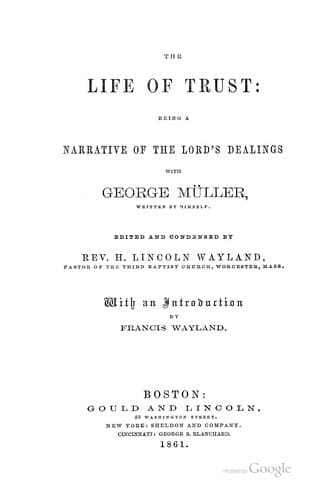
The Life of Trust: Being a Narrative of the Lord's Dealings With George Müller — John Shaqi
The Life of Trust: Being a Narrative of the Lord's Dealings With George MüllerMüller, George
Religion
The Life of Trust: Being a Narrative of the Lord's Dealings With George Müller
Müller, George
Orphanages -- Great Britain; Prayer
Now I do not pretend that we are obliged to receive these words
literally. Unless, however, we believe the Saviour to have spoken
repeatedly on the same subject, at random, and with no definite meaning,
we must understand him to have asserted that things impossible by the
ordinary laws of material causation are possible by faith in God. I do
not perceive, if we allow these words to have any meaning whatever, that
we can ascribe to them any other significance.
"Verily I say unto you, He that believeth in me, the works that I do
shall he do also; and greater works than these shall he do, because I go
unto my Father. And whatsoever ye shall ask in my name, that I will do,
that the Father may be glorified in the Son. If ye shall ask anything in
my name I will do it."[6]
[Footnote 6: John xiv. 12-14.]
"Verily I say unto you, Whatsoever ye shall ask the Father in my name,
he will give it you. Hitherto ye have asked nothing in my name. Ask, and
ye shall receive, that your joy may be full."[7]
[Footnote 7: John xvi. 23, 24.]
"The effectual, fervent prayer of a righteous man _availeth much_;"[8]
that is, it is a real power, a positive energy. The apostle illustrates
what he means by availing prayer by the example of Elias, a man subject
to like passions as we are: "He prayed earnestly that it might not rain,
and it rained not on the earth by the space of three years and six
months; and he prayed again, and the heavens gave rain, and the earth
brought forth her fruit."[9]
[Footnote 8: James v. 16.]
[Footnote 9: James v. 17, 18.]
The conditions on which prayer will be heard are in various places
specified, but particularly in John xv. 7: "If ye abide in me and my
words abide in you, ye shall _ask what ye will_, and it shall be done
unto you." That is, if I understand the passage, prevalence in prayer is
conditioned by the conformity of our souls to the will of God; "if ye
abide in me and my words abide in you." On this condition, and on this
only, may we ask what we will, with the assurance that it will be done
unto us. Faith, in its most simple meaning, is that temper of the mind
in the creature which responds to every revealed perfection of the
Creator. Just according to the degree in which this correspondence
exists, is the promise made that we shall have whatsoever we ask.
It is evident, from the eleventh of Hebrews, that the views of the
Apostle Paul concerning faith were entirely in harmony with the passages
recited above. He reviews the lives of the most eminent saints, for the
express purpose of showing that the impressive events in their history,
whether physical or moral, were controlled entirely by faith. He sums up
the whole in this remarkable language:--
Public-domain text, read in full here on John Shaqi.
Reviews
Reviews
No reviews yet
Be the first to share your thoughts on this work.
Join the Discussion
Join the discussion
Sign in to leave a comment or review.
Sign InorCreate an account