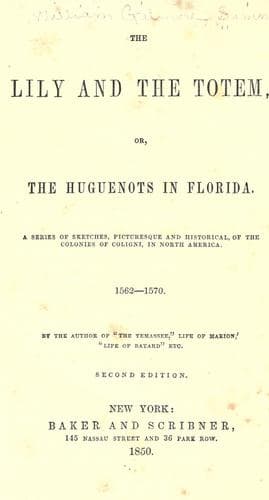
The Lily and the Totem; or, The Huguenots in FloridaSimms, William Gilmore
History
The Lily and the Totem; or, The Huguenots in Florida
Simms, William Gilmore
Florida -- History -- Huguenot colony, 1562-1565 -- Fiction
At that moment, the keen, quick glance of the lieutenant beheld the
rapid bounds of the savage, as he made for the cover of the neighboring
thicket. His orders were instantly given. A dozen bodies instantly
sprang forward in pursuit--a dozen matchlocks were lifted in deadly aim,
but the lithe savage doubling like a hare, bounding forward, now squat,
and seeming to fly along the surface of the ground like a lapwing,
stealthy in every movement as a cat, as swift and agile,--succeeded in
gaining the woods, though the carbines rang with their volley, and,
throwing down their weapons, a score of the light-limbed Frenchmen
started in the chase. A wild warwhoop followed the discharge of the
pieces, declaring equally the defiance and disdain of the savage. The
pursuit was idle, as a few seconds enabled him to find shelter in a
morass, which the inexperienced Europeans knew not how to penetrate.
Alphonse D'Erlach recalled his men from pursuit, fearing lest they
might fall into an ambush, in which, wasting their ammunition against
invisible enemies, they would only incur the risk of total destruction.
He prepared to confront the stranger, whose first appearance had been
productive of such a startling occurrence. Le Genré, meanwhile, had
paused in his progress. He no longer rushed forward like a maniac; but
satisfied with having given the impulse to the pursuit of Oolenoe, and
apparently conscious of how much was startling in his appearance, he now
stood beside a pine which overhung the path, one hand resting against
the mighty shaft, as if from fatigue, while from the other his _couteau
de chasse_ now drooped, its sharp extremity pointing to the ground.
His appearance thus indicated a pacific disposition; but remembering his
ancient treacheries only, and suspicious of his relations with Oolenoe,
D'Erlach approached him with caution, as if to the encounter with an
enemy. As he drew nigh, followed by his band, Le Genré addressed them
with mournful accents.
"Is there no faith for me hereafter, _mes amis_? Am I forever cut off
from the communion with my comrades? Shall there be no fellowship
between us, D'Erlach? Shall we not forget the past--shall I not be
forgiven for my crime, even when I repent it in bitterness and bloody
tears. Behold, my brother--I proffer you the last assurance."
These words were accompanied by a sign, that of the mystic
brotherhood--the ancient masons--which none but a few of the party
beheld or comprehended. The weapon of Alphonse D'Erlach was dropped
instantly, and his hand extended. He, too, belonged to the ancient
order, and the security which was guaranteed by the exhibition of its
token, on the part of the offender, served, when all other pleas would
have failed, to secure him sympathy and protection.
Public-domain text, read in full here on John Shaqi.
Reviews
Reviews
No reviews yet
Be the first to share your thoughts on this work.
Elsewhere in the archive
Join the Discussion
Join the discussion
Sign in to leave a comment or review.
Sign InorCreate an account