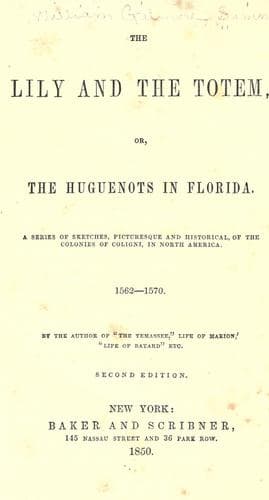
The Lily and the Totem; or, The Huguenots in FloridaSimms, William Gilmore
History
The Lily and the Totem; or, The Huguenots in Florida
Simms, William Gilmore
Florida -- History -- Huguenot colony, 1562-1565 -- Fiction
"We set out thus for the country of the enemy, the lord of Calos leading
the way upon the march, as is the custom with the Indians, while the foe
is yet at a distance from the spot. But, as we drew nigh to the hills of
the Apalachian, the young men were scattered on every hand, as so many
light troops. They covered all the paths, they harbored in all places
where they could maintain watch and find security, and nightly they sent
in runners to the camp, reporting their discoveries. I entreated of the
lord of Calos to be sent with these young men; but, whether he feared
that I would seek an opportunity to fly and escape to the enemy, I know
not. He refused, saying that it required scouts of experience,--men who
knew the ways of the country, and that I could be of no use in such
adventures. He was pleased to add that he wished me near him, as one of
his own warriors--that is, the warriors of his family or tribe--that I
might do battle at his side, and in his sight!
"We were not long in finding the enemy, who had received tidings of our
approach. Several battles were fought, in which I did myself credit in
the eyes of our warriors. The lord of Calos was greatly pleased. He took
me with him into counsel, and it was fortunate that the advice which
I gave, as to the conduct of the war, was adopted, and was greatly
successful. Many were the warriors of the mountain whom we slew. Many
scalps were taken, and more than a hundred captive boys and damsels.
These, if young, are always spared, and taken into the conquering tribe.
The former are newly marked with the totem of the people who take them,
while the latter become the wives of the chiefs, who greatly value them.
I confess to you, my brethren, that I was guilty of the sin of taking
one of these same women into my cabin, who was to me as a wife, though
no holy priest, with appointed ceremonials of the church, gave his
sanction to our communion. She was a lovely and a loving creature,
scarcely sixteen, but very fair, almost like a Spaniard, and of hair so
long that she hath thrice wrapt it around her own neck and mine."
"Why didst thou not tell me of that woman?" said Laudonniere,
interrupting the narrator. "Had we known, she should have been procured
with thee. But, even now, it is not too late. We will bid the chief,
Onathaqua, send her after thee, so that thou may'st wed her according
to the rites of the church."
"Alas!" replied Barbu, "thou compellest me, Señor Laudonniere, to
unravel sin after sin before thee. I have greatly erred and wandered
from the paths of virtue, and from the laws of Holy Church, in my
grievous sojourn among the savages. That woman filled no longer the
place which she had at first in my affections. With increase of power
and security, I grew wanton. I grew weary of her, and sold her to one of
the chiefs for a damsel of his own house, which mine eyes coveted."
Public-domain text, read in full here on John Shaqi.
Reviews
Reviews
No reviews yet
Be the first to share your thoughts on this work.
Elsewhere in the archive
Join the Discussion
Join the discussion
Sign in to leave a comment or review.
Sign InorCreate an account