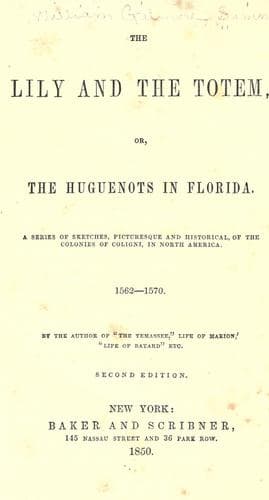
The Lily and the Totem; or, The Huguenots in FloridaSimms, William Gilmore
History
The Lily and the Totem; or, The Huguenots in Florida
Simms, William Gilmore
Florida -- History -- Huguenot colony, 1562-1565 -- Fiction
The Spaniard hung his head as he made this confession, while Laudonniere
with severe aspect rated him for his lecheries. When the captain had
ceased his rebuke, Le Barbu continued his story thus:
"We gained many battles in this war with the mountain Indians, who are
neither so fierce, nor so subtle as those who dwell along the regions of
the sea. Verily, the people of the lord of Calos are great dissemblers,
treacherous beyond the serpent, valiant of their persons, and fight with
excellent address. Great was the favor which I found with them because
of my conduct in the war; and, in each succeeding war, for a space of
six years, I became, in like manner, distinguished, until I became a
most favorite chief with the lord of Calos, and a bosom friend and
companion of his son--he whom I had rescued from the stag, and who had
now grown up to manhood. Greatly did this lad favor his father. He was
of a light olive complexion, scarcely more dark than the people of
Spanish race, but superior in stature, well-limbed, and of admirable
dexterity. With him I hunted from the fall of the leaf in autumn, to the
budding of the leaf again in spring; and, when the summer time came, we
sped away in our canoes, up the vast rivers of the country, through
great lakes, many of which lie embadey in forests of mangrove and
palm, where the forest swims upon the water. If it were possible for a
Christian man--for one who has heard the sound of a great bell in the
cities of the old world, and who has communed with the various good and
wondrous things of civilization--to be content with a loss of these, and
their utter exclusion from sight for ever, then might I have passed
pleasantly the years of my captivity among the people of Calos. I had
become a chief and was greatly honored. I had power and I was much
feared. I had wealth--such wealth as the savage estimates--and I was
loved; and the lord of Calos and his noble son, put in me a faith which
never betrayed a doubt or a denial. But I had not power to shield my
brother Christians, save in one case. Each year witnessed the sacrifice
of a comrade. They were the victims to the Iawas. The priesthood was a
power under which the kings themselves were made to tremble. With them
was it to determine upon peace or war, life or death, bonds or freedom;
and the strength of the king lay greatly in his alliance with the
priesthood. But for this, the rule among the savage nations would be
wholly with the people. Season after season, when came the harvest, one
of our luckless Spaniards was taken away from the rest and doomed to the
sacrifice. In this way the savages propitiate the unknown God, to whom
they looked for victory over their enemies. Do not suppose that I beheld
this cruelty without toiling against it. But I spoke in vain. I made
angry the Iawas, until the lord of Calos himself addressed me, after
this fashion--'Son of the stranger, art thou not well thyself? Why
Public-domain text, read in full here on John Shaqi.
Reviews
Reviews
No reviews yet
Be the first to share your thoughts on this work.
Elsewhere in the archive
Join the Discussion
Join the discussion
Sign in to leave a comment or review.
Sign InorCreate an account