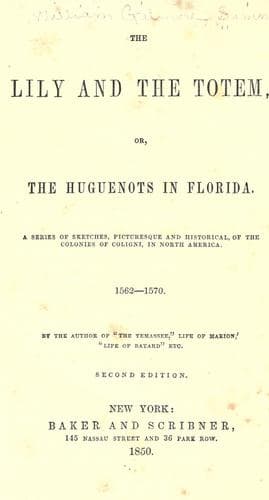
The Lily and the Totem; or, The Huguenots in FloridaSimms, William Gilmore
History
The Lily and the Totem; or, The Huguenots in Florida
Simms, William Gilmore
Florida -- History -- Huguenot colony, 1562-1565 -- Fiction
his friend hath gathered it. Let his friend beware the arrow of the
warrior, and the deadly fang of the war-rattle, for the path between
us is everywhere sown with the darts of death.'
"Thus he spake, and I was silent. I was guilty. I could not excuse
myself, and did not entreat. I felt the truth of his complaint and the
justice of his anger. I felt how great had been my folly and my crime.
Istakalina was lost to us both. Thus then, a fugitive, and an outlaw
from Calos, dreading every moment the vengeance of Wa-ha-la and his
warriors, I dwelt for seven years with Onathaqua, who hath ever treated
me as a son. I have fought among his warriors, and shared the fortunes
of his people, of which nothing more need be said. Tidings at length
came to me, of a people in the country bearded like myself. Then came
your messengers to Onathaqua, and you behold me here. I looked not for
Frenchmen but for Spaniards. I thank and praise the Blessed Mother of
God, that I have found friends if not countrymen, and that I see, once
more, the faces of a Christian people."
Thus ended the narrative of Le Barbu, or the Bearded Man of Calos.
XVIII.
HISTORICAL SUMMARY.
We have already mentioned that, with the restoration of Laudonniere
to power, and the complete subjection of his mutineers, he resumed by
degrees his projects of exploration and discovery. Among other places to
which he sent his barks, was the territory of King Audusta, occupying
that region in which Fort Charles had been erected by Ribault, in the
first attempt to colonize in the country. To Audusta, himself, were
sent two suits of apparel, with knives, hatchets and other trifles;
"the better," as Laudonniere says, "to insinuate myselfe into his
friendship." To render this hope more plausible, "I sent in the barke,
with Captaine Vasseur, a souldier called Aimon, which was one of those
which returned home in the first voyage, hoping that King Audusta might
remember him." This Aimon was instructed to inquire after another
soldier named Rouffi, who, it appears, had preferred remaining in the
country, when it had been abandoned by the colonists under Nicolas
Barré.
Public-domain text, read in full here on John Shaqi.
Reviews
Reviews
No reviews yet
Be the first to share your thoughts on this work.
Elsewhere in the archive
Join the Discussion
Join the discussion
Sign in to leave a comment or review.
Sign InorCreate an account