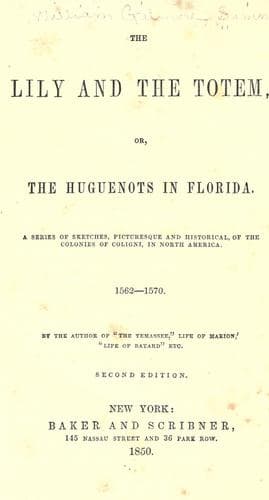
The Lily and the Totem; or, The Huguenots in FloridaSimms, William Gilmore
History
The Lily and the Totem; or, The Huguenots in Florida
Simms, William Gilmore
Florida -- History -- Huguenot colony, 1562-1565 -- Fiction
Audusta received his visitors with great favor,--sent back to
Laudonniere a large supply of "mil, with a certaine quantity of beanes,
two stagges, some skinnes painted after their manner, and certaine
pearles of small value, because they were burnt." The old chief invited
the Frenchmen once more to remove and plant in his territories. He
proffered to give him a great country, and would always supply him with
a sufficient quantity of grain. Audusta had known the Frenchmen almost
entirely by benefits and good fellowship. The period of this visit to
Audusta, which was probably in the month of December, is distinguished
in the chronicle of Laudonniere, by expressions of delightful surprise
at the number of stock doves (wild pigeons) which came about the
garrison--"in so greate number, that, for the space of seven weekes
together," they "killed with harquebush shot at least two hundred every
day." This was good feeding. On the return of Capt. Vasseur from his
visit to Audusta, he was sent with a present "unto the widow of Kinge
Hiocaia, whose dwelling was distant from our fort about twelve leagues
northward. She courteously received our men, sent me backe my barkes,
full of mil and acornes, with certaine baskets full of the leaves of
cassine, wherewith they make their drinke. And the place where this
widow dwelleth, is the most plentifull of mil that is in all the coast,
and the most pleasante. It is thought that the queene is the most
beautiful of all the Indians, and of whom they make the most account:
yea, and her subjects honour her so much that almost continually they
beare her on their shoulders, and will not suffer her to go on foot."
The visit of Laudonniere, through his lieutenant, was returned, in a few
days, by the beautiful widow, through her Hiatiqui, "which is as much as
to say, her Interpreter."
Laudonniere continued his explorations, still seeking provisions, and
with the view to keeping his people from that idleness which hitherto
had caused such injurious discontents in his garrison. His barks were
sent up May River, to discover its sources, and make the acquaintance of
the tribes by which its borders were occupied. Thirty leagues beyond the
place called Mathiaqua, "they discovered the entrance of a lake, upon
the one side whereof no land can be seene, according to the report of
the Indians, which had oftentimes climbed on the highest trees in the
country to see land, and notwithstanding could not discerne any."
Public-domain text, read in full here on John Shaqi.
Reviews
Reviews
No reviews yet
Be the first to share your thoughts on this work.
Elsewhere in the archive
Join the Discussion
Join the discussion
Sign in to leave a comment or review.
Sign InorCreate an account