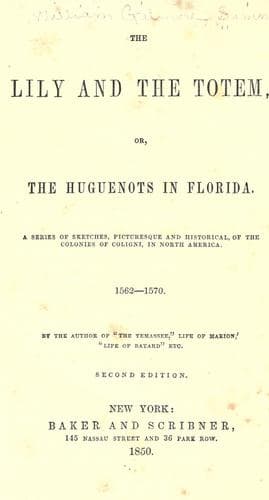
The Lily and the Totem; or, The Huguenots in FloridaSimms, William Gilmore
History
The Lily and the Totem; or, The Huguenots in Florida
Simms, William Gilmore
Florida -- History -- Huguenot colony, 1562-1565 -- Fiction
coverlets of cotton ingeniously manufactured, and richly stained with
the bright crimson, scarlet, and yellow, of native dye-woods. This art
of dyeing, the savages had brought to a comparatively high state of
perfection. His house itself stood upon an artificial eminence of earth,
raised in the very centre of his village, and overlooking it on every
hand. It was an airy structure, with numerous openings, and the breeze
played sweetly and capriciously among the coverlets which hung as
curtains before the several places of egress and entrance. Utina himself
was a savage of noble size and appearance. He carried himself with the
ease and dignity of one born to the purple. His form, though an old man,
was still unbending and tall. His countenance was one of great spirit
and nobleness. With forehead equally large and high, with a dark eye
that flashed with all the fires of youth, with lips that opened only to
discourse in tones of a sweet but majestic eloquence, and with a shrewd
sagacity, that made him, among a cunning people, a recognised master
of all the arts of the serpent, he was necessarily a person to impress
with respect and admiration those even who came with hostility.
It is probable that Utina knew nothing of the approach of the Frenchmen,
until it was too late to escape them. But, before they entered the
opened space assigned to the settlement, he was advised of their coming.
Then it was that he threw aside his domestic habit and assumed his
state. Then it was that he resumed his dignity and ascended the _dais_
of stained cotton and flowing deer-skin. His turban of purple and yellow
cotton was bound skilfully about his brow, his bow and quiver lay beside
him, while at his feet was extended his huge macana, or war-club, which
it scarcely seemed possible that his aged hands should now grasp with
vigor sufficient for its formidable use. His hands, when the Frenchmen
entered the dwelling, held nothing more formidable than the earthen
pipe, and the long tubulated reed which he busied himself in inserting
within the bowl. Two of his attendant warriors retired at the same
moment. These, Laudonniere did not think proper to arrest, though
counselled to do so by D'Erlach. He knew not that they had been
despatched by the wily Paracoussi for the purpose of gathering his
powers for resistance.
Public-domain text, read in full here on John Shaqi.
Reviews
Reviews
No reviews yet
Be the first to share your thoughts on this work.
Elsewhere in the archive
Join the Discussion
Join the discussion
Sign in to leave a comment or review.
Sign InorCreate an account