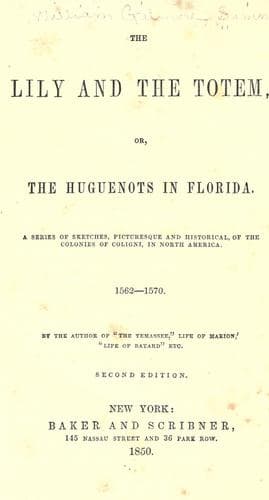
The Lily and the Totem; or, The Huguenots in FloridaSimms, William Gilmore
History
The Lily and the Totem; or, The Huguenots in Florida
Simms, William Gilmore
Florida -- History -- Huguenot colony, 1562-1565 -- Fiction
The design of the narrative which follows, contemplates, in nearly equal
degree, the picturesque and the historical. It belongs to a class of
writings with which the world has been long since made familiar, through
a collection of the greatest interest, the body of which continues to
expand, and which has been entitled the "Romance of History." This name
will justly apply to the present sketches, yet must not be construed to
signify any large or important departure, in the narrative, from the
absolute records of the Past. The romance here is not suffered to
supersede the history. On the contrary, the design of the writer has
been simply to supply the deficiencies of the record. Where the author,
in this species of writing, has employed history, usually, as a mere
loop, upon which to hang his lively fancies and audacious inventions,
embodying in his narrative as small a portion of the chronicle as
possible, I have been content to reverse the process, making the fiction
simply tributary, and always subordinate to the fact. I have been
studious to preserve all the vital details of the event, as embodied in
the record, and have only ventured my own "graffings" upon it in those
portions of the history which exhibited a certain baldness in their
details, and seemed to demand the helping agency of art. In thus
interweaving the history with the fiction, I have been solicitous always
of those proprieties and of that _vraisemblance_, in the introduction
of new details, which are essential to the chief characteristics of the
history; seeking equally to preserve the general integrity of the record
from which I draw my materials, and of that art which aims to present
them in a costume the most picturesque. My labor has been not to make,
but to perfect, a history; not to invent facts, but to trace them out
to seemingly inevitable results;--to take the premise and work out the
problem;--recognize the meagre record which affords simply a general
outline; and endeavor, by a severe induction, to supply its details and
processes. I have been at no such pains to disguise the chronicle,
as will prevent the reader from separating,--should he desire to do
so,--the _certain_ from the _conjectural_; and yet, I trust, that I have
succeeded in so linking the two together, as to prevent the lines of
junction from obtruding themselves offensively upon his consciousness.
Upon the successful prosecution of this object, apart from the native
interest which the subject itself possesses, depends all the merit of
the performance. It is by raising the tone of the history, warming it
with the hues of fancy, and making it dramatic by the continued exercise
of art, rather than by any actual violation of its recorded facts, that
I have endeavored to awaken interest. To bring out such portions of the
event as demand elevation--to suppress those which are only cumbrous,
and neither raise the imposing, nor relieve the unavoidable; and to
Public-domain text, read in full here on John Shaqi.
Reviews
Reviews
No reviews yet
Be the first to share your thoughts on this work.
Join the Discussion
Join the discussion
Sign in to leave a comment or review.
Sign InorCreate an account