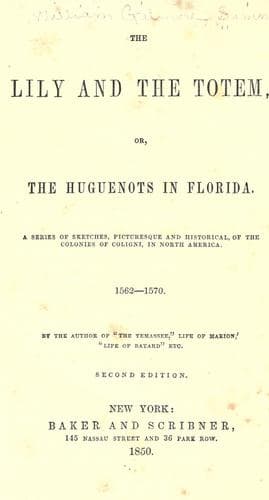
The Lily and the Totem; or, The Huguenots in FloridaSimms, William Gilmore
History
The Lily and the Totem; or, The Huguenots in Florida
Simms, William Gilmore
Florida -- History -- Huguenot colony, 1562-1565 -- Fiction
Ribault was not dissatisfied with this result of his endeavor to comply
with the commands of the Queen-mother. His sense of justice probably
revolted at the proceeding; and the escape of the Indians, who would
report only the kindness of their treatment, would, in all likelihood,
have an effect favorable to his main enterprise,--the establishment of
a colony. This design he now broached to his people in an elaborate
speech. He enlarged upon the importance of the object, drawing numerous
examples from ancient and modern history, in favor of those virtues in
the individual which such enterprise must develope. There is but one
passage in this speech which deserves our special attention. It is
that in which he speaks to his followers of their inferior birth and
condition. He speaks to them as "known neither to the king nor to the
princes of the realme, and, besides, descending from so poore a stock,
that few or none of your parents, _having ever made profession of
armes_, have beene knowne unto the great estates." This is in seeming
conflict with what Laudonniere has already told us touching the
character and condition in society of the persons employed in the
expedition. He has been careful to say, at the opening of the narrative,
that the two ships were "_well furnished with gentlemen_ (of whose
number I was one) and old soldiers."[5] The apparent contradiction may
be reconciled by a reference to the distinction, which, until a late
period, was made in France, between the noblesse and mere gentlemen. The
word gentleman had no such signification, in France, at that period, as
it bears to-day. To apply it to a nobleman, indeed, would have been, at
one time, to have given a mortal affront, and a curious anecdote is on
record, to this effect in the case of the Princess de la Roche Sur Yon,
who, using the epithet "gentilhomme" to a nobleman, was insulted by him;
and, on demanding redress of the monarch, was told that she deserved the
indignity, having been guilty of the first offence.
[5] Charlevoix seems to afford a sufficient sanction for the claim
of Laudonniere, in behalf of the gentle blood among the followers
of Ribault. He says "Il avoit des esquipages choisis, et plusieurs
volontaires, parmi lesquels il y avoit _quelques gentilshommes_." And
yet Ribault should have known better than anybody else the quality of
his armament. Certainly, the good leaven, as the result showed, was in
too small a proportion to leaven the whole colony.
Public-domain text, read in full here on John Shaqi.
Reviews
Reviews
No reviews yet
Be the first to share your thoughts on this work.
Join the Discussion
Join the discussion
Sign in to leave a comment or review.
Sign InorCreate an account