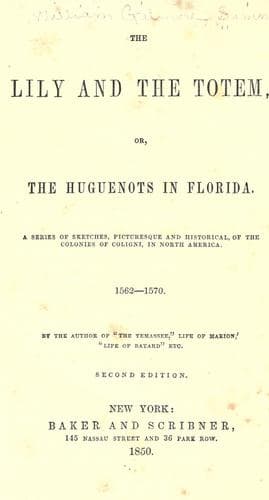
The Lily and the Totem; or, The Huguenots in FloridaSimms, William Gilmore
History
The Lily and the Totem; or, The Huguenots in Florida
Simms, William Gilmore
Florida -- History -- Huguenot colony, 1562-1565 -- Fiction
The glowing accounts of the delights of the Floridian Eden which were
brought by our returning voyagers, were not sufficient to persuade
the garrison to forego their anxious desire to return to France. The
home-sickness under which they labored had now reached such a height
as to suffer no appeal or opposition. Nothing but the stern decree of
authority could have silenced the discontents; and the authority lay
neither in the will nor in the numbers under the control of Laudonniere.
To such a degree of impatience had this passion for their European
homes arisen, that, when it was found that the building of the vessel
for their deportation would be delayed beyond the designated period,
in consequence of the death, in battle with the savages, of two of the
carpenters, the multitude rose in mutiny setting upon Jean de Hais, the
master-carpenter,--who had innocently declared the impossibility of
doing the work within the given time,--with such ferocity, as to make it
scarcely possible to save his life. With this spirit prevailing among
his garrison, Laudonniere was compelled to abandon the idea, altogether,
of building the ship; and to address all his energies to the repair, for
the desired purpose, of the old brigantine, which had been brought back
to La Caroline, by the returning pirates. To work, with this object, all
parties were now set with the utmost expedition. The houses which had
been built without the fort were torn down, in order that the timber
should be converted into coal for the uses of the forge; this being
a labor much easier than that of using the axe upon the trees of the
forest. The palisade which conducted from the fort to the river was
torn down also by the soldiery, for the same purpose, in spite of
the objections of Laudonniere. It was their policy to make their
determination to depart inevitable, by rendering the place no longer
habitable. The fort, itself, it was determined to destroy, when they
were ready to sail, "lest some new-come guest should have enjoyed and
possessed it." Our Frenchmen were very jealous of the designs of the
English queen. They well knew that the haughty and courageous Elizabeth
was meditating a British settlement in the New World; and though, after
their own voluntary abandonment of the country, they had no right
to complain that another should occupy the waste places, yet their
jealousy was too greatly that of the dog in the manger, to behold,
with pleased eye, the possession by another of the things which
they themselves had been unable to enjoy. "In the meanwhile," says
Laudonniere--seeking to excuse his own unwise management and feeble
policy--"In the meanwhile, there was none of us to whome it was not an
extreme griefe to leave a country wherein wee had endured so greate
travailes and necessities, to discover that which wee must forsake
through our owne countrymen's default. For if wee had beene succoured in
time and place, and according to the promise that was made unto us, the
Public-domain text, read in full here on John Shaqi.
Reviews
Reviews
No reviews yet
Be the first to share your thoughts on this work.
Elsewhere in the archive
Join the Discussion
Join the discussion
Sign in to leave a comment or review.
Sign InorCreate an account