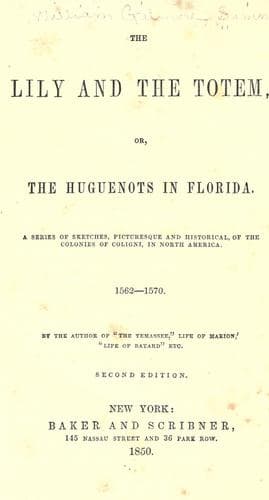
The Lily and the Totem; or, The Huguenots in FloridaSimms, William Gilmore
History
The Lily and the Totem; or, The Huguenots in Florida
Simms, William Gilmore
Florida -- History -- Huguenot colony, 1562-1565 -- Fiction
war which was between us and Utina had not fallen out, neither should
wee have had occasion to offend the Indians, which, with all paines in
the world, I entertained in good amitie, as well with merchandize and
apparel, as with promise of greater matters; and with whome I so behaved
myself, that although sometimes I was constrained to take victuals in
some few villages, yet I lost not the alliance of eight kings and lords,
my neighbours, which continually succoured and ayded me with whatever
they were able to afford. Yea, this was the principal scope of all my
purposes, to winne and entertaine them, knowing how greatly their amitie
might advance our enterprise, and principally while I discovered the
commodities of the country, and sought to strengthen myself therein. I
leave it to your cogitation to think how neare it went to our hearts
to leave a place abounding in riches (as we were thoroughly enformed
thereof) in coming whereunto, and doing service unto our prince, we
lefte our owne countrey, wives, children, parents and friends, and
passed the perils of the sea, and were therein arrived as in a plentiful
treasure of all our heart's desire."
It was while distressing himself with these cogitations that
Laudonniere, on the 3d of August, 1565, took a walk, "as was his custom
of an afternoon," to the top of a little eminence, in the neighborhood
of the fort, which afforded a distant prospect of the sea. Here, looking
forth with yearning to that watery waste which he was preparing to
traverse, he was suddenly excited, as he beheld four sail of approaching
vessels. At first, the tidings made the soldiers of the garrison to leap
for joy. The vessels were naturally supposed to be those of their own
countrymen; and such was the gladness inspired by this supposition, that
"one would have thought them to be out of their wittes, to see them
laugh and leap." But, something in the behavior of the strange ships,
after a while, rendered our Frenchmen a little doubtful of their
character. Instead of boldly approaching, they were seen to cast anchor
and to send out one of their boats. A prudent fear of the Spaniards made
Laudonniere get his soldiers in readiness; while Captain La Vasseur,
with a select party, advanced to the river side to meet the visitors.
They proved to be Englishmen--a fleet under the command of the
celebrated John Hawkins; and had on board one Martin Atinas, of Dieppe;
a Frenchman, who had been one of the colonists of Fort Charles,--one of
those who, returning to France, had been taken up at sea and carried
into England. He had guided the English admiral along the coast, and his
information had contributed to prompt the voyage of exploration which
Hawkins had in hand. But the object of the British admiral was quite
pacific, and his conduct exceedingly generous and noble. His ostensible
purpose in putting into May River was to procure fresh water.
Laudonniere permitted him to do so. Hawkins, perceiving the distressed
Public-domain text, read in full here on John Shaqi.
Reviews
Reviews
No reviews yet
Be the first to share your thoughts on this work.
Elsewhere in the archive
Join the Discussion
Join the discussion
Sign in to leave a comment or review.
Sign InorCreate an account