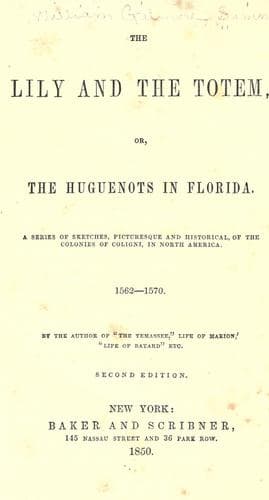
The Lily and the Totem; or, The Huguenots in FloridaSimms, William Gilmore
History
The Lily and the Totem; or, The Huguenots in Florida
Simms, William Gilmore
Florida -- History -- Huguenot colony, 1562-1565 -- Fiction
They were, indeed, favors to the musician, though, to what extent,
Albert entertained no suspicion. It so happened that among his other
conquests, Guernache had made that of a very lovely dark-eyed damsel, a
niece of Audusta, and a resident of the king's own village. After the
informal fashion of the country, into which our Frenchmen were apt
readily to fall, he had made the damsel his wife. She was a beautiful
creature, scarcely more than sixteen; tall and slender, and so naturally
agile and graceful, that it needed but a moderate degree of instruction
to make her a dancer whose airy movements would not greatly have
misbeseemed the most courtly theatres of Paris. Monaletta,--for such was
the sweet name of the Indian damsel,--was an apt pupil, because she was
a loving one. She heartily responded to that sentiment of wonder--common
among the savages--that the Frenchmen should place themselves under the
command of a chief, so mean of person as Albert, and so inferior in
gifts, when they had among them a fellow of such noble presence as
Guernache, whose qualities were so irresistible. The opinions of her
head were but echoes from the feelings in her heart. Her preference for
our musician was soon apparent and avowed; but, in taking her to wife,
Guernache kept his secret from his best friend. No one in Fort Charles
ever suspected that he had been wived in the depth of the great
forests, through pagan ceremonies, by an Indian Iawa,[10] to the lovely
Monaletta. Whatever may have been his motive for keeping the secret,
whether he feared the ridicule of his comrades, or the hostility of his
superior, or apprehended a difficulty with rivals among the red men, by
a discovery of the fact, it is yet very certain that he succeeded in
persuading Monaletta, herself, and those who were present at his wild
betrothal, to keep the secret also. It did not lessen, perhaps, the
pleasure of his visits to the settlements of Audusta, that the peculiar
joys which he desired had all the relish of a stolen fruit. It was now,
only in this manner that Monaletta could be seen. Captain Albert, with
a rigid austerity, which contributed also to his evil odor among his
people, had interdicted the visits of all Indian women at the fort. This
interdict was one, however, which gave little annoyance to Guernache.
A peculiar, but not unnatural jealousy, had already prompted him
repeatedly to deny this privilege to Monaletta. The simple savage had
frequently expressed her desire to see the fortress of the white man, to
behold his foreign curiosities, and, in particular, to hearken to the
roar of that mimic thunder which he had always at command, and which,
when heard, had so frequently shaken the very hearts of the men of her
people.
[10] Iawa was the title of the priest or prophet of the Floridian.
The word is thus written by Laudonniere in Hakluyt. It is probably a
misprint only which, in Charlevoix, writes it "Iona."
Public-domain text, read in full here on John Shaqi.
Reviews
Reviews
No reviews yet
Be the first to share your thoughts on this work.
Join the Discussion
Join the discussion
Sign in to leave a comment or review.
Sign InorCreate an account