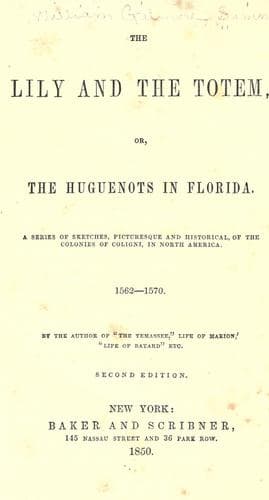
The Lily and the Totem; or, The Huguenots in FloridaSimms, William Gilmore
History
The Lily and the Totem; or, The Huguenots in Florida
Simms, William Gilmore
Florida -- History -- Huguenot colony, 1562-1565 -- Fiction
happily to consort with their dark, but not unpleasing complexions.
Well, indeed, with a pardonable vanity, might their people call them the
"Daughters of the Sun." He had made them his, by his warmest and fondest
glances. These were the women, whose descendants, in after days, as
Yemassees and Muscoghees and Seminoles, became the scourge of so large
a portion of the Anglo-American race.
When the Frenchmen beheld this rude, but really brilliant assemblage,
and saw what an attractive show the young damsels made, they were
delighted beyond measure. Visions of the rout and revel, as enjoyed in
_La Belle France_, glanced before their fancies; and the lively capering
that followed among the young Huguenots, informed Captain Albert of the
desire which was felt by all. In stern, compelling accents, he bade
Guernache take his violin, and provide the music, while the rest
prepared to dance. But Guernache excused himself, alleging the want of
strings for his instrument. These were shown, in a broken state, to
his commander. He had broken them, we may state _en passant_, for the
occasion. His pride had been hurt by the treatment of his captain.
He felt that the purpose of the latter was to degrade him. Such a
performance as that required at his hands, was properly no part of his
duty; and his proud spirit revolted at the idea of contributing, in any
way, to the wishes of his superior, when the object of the latter was
evidently his own degradation. Albert spoke to him testily, and with
brows that did not seek to subdue or conceal their frowns. But Guernache
was firm, and though he studiously forebore, by word or look, to
increase the provocation which he had already given, he yet made no
effort to pacify the imperious nature which he had offended. The excuse
was such as could not but be taken. There was the violin, indeed, but
there, also, were the broken strings. Albert turned from the musician
with undisguised loathing; and the poor fellow sunk back with a secret
presentiment of evil. He but too well knew the character of his
superior.
Public-domain text, read in full here on John Shaqi.
Reviews
Reviews
No reviews yet
Be the first to share your thoughts on this work.
Join the Discussion
Join the discussion
Sign in to leave a comment or review.
Sign InorCreate an account