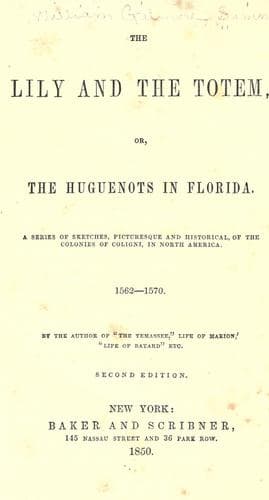
The Lily and the Totem; or, The Huguenots in FloridaSimms, William Gilmore
History
The Lily and the Totem; or, The Huguenots in Florida
Simms, William Gilmore
Florida -- History -- Huguenot colony, 1562-1565 -- Fiction
The Huguenots, in plain terms, were the Protestants of France. They were
a sect which rose very soon after the preaching of the Reformation had
passed from Germany into the neighboring countries. In France, they
first excited the apprehensions and provoked the hostility of the Roman
Catholic priesthood, during the reign of Francis the First. This prince,
unstable as water, and governed rather by his humors and caprices than
by any fixed principles of conduct--wanting, perhaps, equally in head
and heart--showed himself, in the outset of his career, rather friendly
to the reformers. But they were soon destined to suffer, with more
decided favorites, from the caprices of his despotism. He subsequently
became one of their most cruel persecutors. The Huguenots were not
originally known by this name. It does not appear to have been one of
their own choosing. It was the name which distinguished them in the days
of their persecution. Though frequently the subject of conjecture, its
origin is very doubtful. Montluc, the Marshal, whose position at the
time, and whose interests in the subject of religion were such as might
have enabled him to know quite as well as any other person, confesses
that the source and meaning of the appellation were unknown. It is
suggested that the name was taken from the tower of one Hugon, or Hugo,
at Tours, where the Protestants were in the habit of assembling secretly
for worship. This, by many, is assumed to be the true origin of the
word. But there are numerous etymologies besides, from which the reader
may make his selection,--all more or less plausibly contended for
by the commentators. The commencement of a petition to the Cardinal
Lorraine--"_Huc nos_ venimus, serenissime princeps, &c.," furnishes a
suggestion to one set of writers. Another finds in the words "_Heus
quenaus_," which, in the Swiss _patois_, signify "seditious fellows,"
conclusive evidence of the thing for which he seeks. Heghenen or
Huguenen, a Flemish word, which means Puritans, or Cathari, is
reasonably urged by Caseneuve, as the true authority; while Verdier
tells us that they were so called from their being the _apes_ or
followers of John Hus--"_les guenons de Hus_;"--_guenon_ being a young
ape. This is ingenious enough without being complimentary. The etymology
most generally received, according to Mr. Browning, (History of the
Huguenots,) is that which ascribes the origin of the name to "the word
_Eignot_, derived from the German _Eidegenossen_, q. e. federati. A
party thus designated existed at Geneva; and it is highly probable that
the French Protestants would adopt a term so applicable to themselves."
There are, however, sundry other etymologies, all of which seem
equally plausible; but these will suffice, at least, to increase the
difficulties of conjecture. Either will answer, since the name by which
the child is christened is never expected to foreshadow his future
character, or determine his career. The name of the Huguenots was
Public-domain text, read in full here on John Shaqi.
Reviews
Reviews
No reviews yet
Be the first to share your thoughts on this work.
Join the Discussion
Join the discussion
Sign in to leave a comment or review.
Sign InorCreate an account