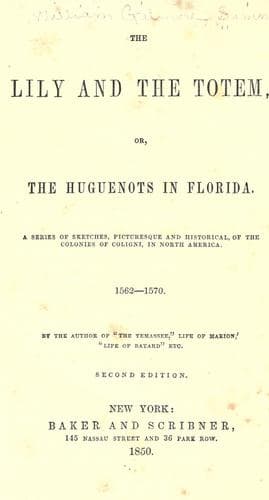
The Lily and the Totem; or, The Huguenots in FloridaSimms, William Gilmore
History
The Lily and the Totem; or, The Huguenots in Florida
Simms, William Gilmore
Florida -- History -- Huguenot colony, 1562-1565 -- Fiction
Not only was no peace in the colony after the execution of Guernache,
but the evil spirit, in the mood of Captain Albert, was very far from
being laid. "His madness," in the language of the chronicler, "seemed to
increase from day to day." He was not content to punish Guernache; he
determined to extend his severities to the friends and associates of
the unhappy victim. Some of these he only frowned upon and threatened;
but his threats were apt to be fulfilled. Others he brought up for
punishment;--sympathy with his enemy, being a prime offence against the
dignity and safety of our petty sovereign. Among those who had thus
rendered themselves obnoxious, Lachane was necessarily a conspicuous
object. In the same unwise and violent spirit in which he had pursued
Guernache, Captain Albert was determined to proceed against this man,
who was really equally inoffensive with Guernache, and quite as much
beloved among the people. But the aspect of the two cases was not
precisely the same. The friends of Lachane, warned by the fate of
Guernache, were somewhat more upon their guard,--more watchful and
suspicious,--and inclined to make the support and maintenance of the
one, a tribute to the manes of the other. Besides, Pierre Renaud, who
had some how been the deadly enemy of Guernache, had no hostility to
Lachane. The latter, too, had not so singularly offended the _amour
propre_ of Captain Albert, by his successful rivalry among the damsels
of Audusta. They had not so decidedly shown the preference for him as
they had for the fiddler, over his superior. No doubt he was preferred,
for he, too, like Guernache, was a person very superior in form and
physiognomy to Albert. But, if they felt any preference for the former,
they had not so offensively declared it, as the indiscreet Monaletta had
done; and, with these qualifying circumstances, in his favor, Lachane
was brought up for judgment. His offence, such as it was, did not admit
of denial. Some palliation was attempted by a reference to the claims
of Guernache, the excellence of his character, his usefulness, and the
general favor he had found equally among the red-men and his own people.
These suggestions were unwisely made. They censured equally the justice
and the policy of the tyrant, and thus irritated anew his self-esteem.
He thought himself exceedingly merciful, accordingly, in banishing the
offender, whom it was just as easy and quite as agreeable to him, to
hang. Lachane was accordingly sentenced to perpetual exile to a desert
island along the sea. To this point he was conducted in melancholy
state, by the trusted creatures of the despot.
Public-domain text, read in full here on John Shaqi.
Reviews
Reviews
No reviews yet
Be the first to share your thoughts on this work.
Elsewhere in the archive
Join the Discussion
Join the discussion
Sign in to leave a comment or review.
Sign InorCreate an account