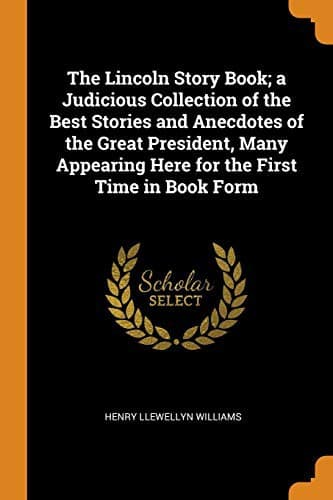
The Lincoln Story Book: A Judicious Collection of the Best Stories and Anecdotes of the Great President, Many Appearing Here for the First Time in Book Form
History
The Lincoln Story Book: A Judicious Collection of the Best Stories and Anecdotes of the Great President, Many Appearing Here for the First Time in Book Form
Lincoln, Abraham, 1809-1865 -- Anecdotes
Produced by Sandra Bannatyne, Tiffany Vergon, Charles
Aldarondo, Charles Franks and the Online Distributed
Proofreading Team
THE LINCOLN STORY BOOK
A Judicious Collection of the Best Stories
and Anecdotes of the Great President,
Many Appearing Here for the
First Time in Book Form
COMPILED BY
HENRY L. WILLIAMS
PREFACE.
The Abraham Lincoln Statue at Chicago is accepted as the typical
Westerner of the forum, the rostrum, and the tribune, as he stood to be
inaugurated under the war-cloud in 1861. But there is another Lincoln
as dear to the common people--the Lincoln of happy quotations, the
speaker of household words. Instead of the erect, impressive,
penetrative platform orator we see a long, gaunt figure, divided
between two chairs for comfort, the head bent forward, smiling broadly,
the lips curved in laughter, the deep eyes irradiating their caves of
wisdom; the story-telling Lincoln, enjoying the enjoyment he gave to
others.
This talkativeness, as Lincoln himself realized, was a very valuable
asset. Leaving home, he found, in a venture at "Yankee notion-pedling,"
that glibness meant three hundred per cent, in disposing of flimsy
wares. In the camp of the lumber-jacks and of the Indian rangers he was
regarded as the pride of the mess and the inspirator of the tent. From
these stages he rose to be a graduate of the "college" of the
yarn-spinner--the village store, where he became clerk.
The store we know is the township vortex where all assemble to "swap
stories" and deal out the news. Lincoln, from behind the counter--his
pulpit--not merely repeated items of information which he had heard,
but also recited doggerel satire of his own concoction, punning and
emitting sparks of wit. Lincoln was hailed as the "capper" of any "good
things on the rounds."
Even then his friends saw the germs of the statesman in the lank,
homely, crack-voiced hobbledehoy. Their praise emboldened him to stand
forward as the spokesman at schoolhouse meetings, lectures,
log-rollings, huskings auctions, fairs, and so on--the folk-meets of
our people. One watching him in 1830 said foresightedly: "Lincoln has
touched land at last."
In commencing electioneering, he cultivated the farming population and
their ways and diction. He learned by their parlance and Bible phrases
to construct "short sentences of small words," but he had all along the
idea that "the plain people are more easily influenced by a broad and
humorous illustration than in any other way." It is the Anglo-Saxon
trait, distinguishing all great preachers, actors, and authors of that
breed.
Public-domain text, read in full here on John Shaqi.
Reviews
Reviews
No reviews yet
Be the first to share your thoughts on this work.
Join the Discussion
Join the discussion
Sign in to leave a comment or review.
Sign InorCreate an account