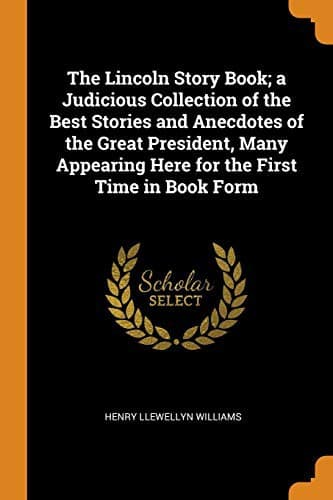
The Lincoln Story Book: A Judicious Collection of the Best Stories and Anecdotes of the Great President, Many Appearing Here for the First Time in Book Form
History
The Lincoln Story Book: A Judicious Collection of the Best Stories and Anecdotes of the Great President, Many Appearing Here for the First Time in Book Form
Lincoln, Abraham, 1809-1865 -- Anecdotes
The President's reply to an autograph fiend who sought his signature,
appended to a sentiment, was:
"DEAR MADAM: When you ask a stranger for that which is of interest only
to yourself, always enclose a stamp."
* * * * *
CHESTNUTS UNDER A SYCAMORE.
The President, on his way to the Department of War, perceived a
gentleman under a tree, scraping among the heaped leaves with his cane.
He knew him, a Major Johnson, of the department, an old District of
Columbia man who had never been out of the district.
"Good morning, major!" hailed the executive officer. "What in the world
are you doing there?"
"Looking for a few horse-chestnuts."
"Eh? Do you expect to find them under a sycamore-tree?" The President
laughed freely and passed on. He ought to have removed the misguided
botanist into the Department of Agriculture, where he might have
learned something.
* * * * *
STILL OF LITTLE NOTE.
On hearing that a man had been arrested in Philadelphia for trying to
procure $1,500 by a forgery of Lincoln's name, he humorously said: "It
is surprising that any man could get the money!"
The secretary pointed out that use might have been made of a signature
given to a stranger as an autograph on a blank paper, the body of which
had been improperly filled up as a note.
"Well," answered the President, then, as to interfering, "I don't see
but that he will have to sit on 'the blister-bench.'"
* * * * *
THE TREE-TOAD AND "TIMOTHEUS."
In the early days when Abraham Lincoln went with his pioneer father to
settle in wild Indiana, the chief diversion of the rude inhabitants was
from the preaching of the traveling pastors. They were singular
devotees whose sincerity redeemed all their flaws of ignorance,
illiteracy, and violence. Abraham, with his inherent proneness toward
imitation of oratory, used to "take them off" to the hilarity of the
laboring men who formed his first audiences. Out of his recollections
came this tale, which he liked to act out with all the quaint tones and
gestures the subject demanded.
The itinerant ranters held out at a schoolhouse near Lincoln's cabin;
but in fine weather preferred the academy--as the Platoists would
say--what was left of an oak grove, only one tree being spared, making
a pulpit with leafy canopy for the exhorter. This man was a Hard-shell
Baptist, commonly imperturbable to outside sights and doings when the
spirit moved him. His demeanor was rigid and his action angular and
restricted. He wore the general attire, coonskin cap or beaver hat,
hickory-dyed shirt, breeches loose and held up by plugs or makeshift
buttons, as our ancestors attached undergarments to the upper ones by
laces and points. The shirt was held by one button in the collar.
Public-domain text, read in full here on John Shaqi.
Reviews
Reviews
No reviews yet
Be the first to share your thoughts on this work.
Elsewhere in the archive
Join the Discussion
Join the discussion
Sign in to leave a comment or review.
Sign InorCreate an account