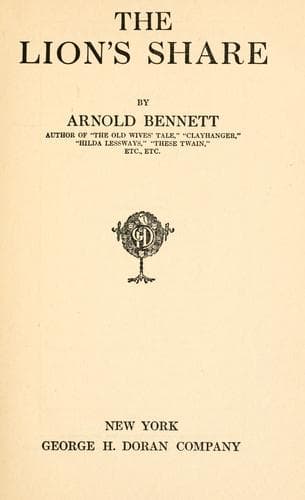
England -- Fiction; Man-woman relationships -- Fiction; Mothers and daughters -- Fiction; Paris (France) -- Fiction; Women -- Fiction
Mr. Moze, hurrying too fast to meet the Bishop of Colchester, had met a
greater than the Bishop.
Audrey glanced an instant with a sick qualm at the outlines of the shape
beneath the tarpaulin, and ran.
In the dining-room, over the speck of fire, Mrs. Moze and Miss Ingate were
locked in a deep intimate gossip.
"Mother!" cried Audrey, and then sank like a sack.
"Why! The little thing's fainted!" Miss Ingate exclaimed in a voice
suddenly hoarse.
CHAPTER III
THE LEGACY
Audrey and Miss Ingate were in the late Mathew Moze's study, fascinated--as
much unconsciously as consciously--by the thing which since its owner's
death had grown every hour more mysterious and more formidable--the safe.
It was a fine afternoon. The secondary but still grandiose enigma of the
affair, Mr. Cowl, could be heard walking methodically on the gravel in the
garden. Mr. Cowl was the secretary of the National Reformation Society.
Suddenly the irregular sound of crunching receded.
"He's gone somewhere else," said Audrey.
"I'm so relieved," said Miss Ingate. "I hope he's gone a long way off."
"Are you?" murmured Audrey, with an air of surprised superiority.
But in secret Audrey felt just as relieved as Miss Ingate, despite the fact
that, her mother being prostrate, she was the mistress of the situation,
and could have ordered Mr. Cowl to leave, with the certainty of being
obeyed. She was astonished at her illogical sensations, and she had been
frequently so astonished in the previous four days.
For example, she was free; she knew that she could impose herself on her
mother; never again would she be the slave of an unreasoning tyrant; yet
she was gloomy and without hope. She had hated the unreasoning tyrant; yet
she felt very sorry for him because he was dead. And though she felt very
sorry for him, she detested hearing the panegyrics upon him of the village,
and particularly of those persons with whom he had quarrelled; she actually
stopped Miss Ingate in the midst of an enumeration of his good
qualities--his charm, his smile, his courtesy, his integrity, et cetera;
she could not bear it. She thought that no child had ever had such a
strange attitude to a deceased parent as hers to Mr. Moze. She had
anticipated the inquest with an awful dread; it proved to be a trifle, and
a ridiculous trifle. In the long weekly letter which she wrote to her
adored school-friend Ethel at Manningtree she had actually likened the
coroner to a pecking fowl! Was it possible that a daughter could write in
such a strain about the inquest on her father's body?
Public-domain text, read in full here on John Shaqi.
Reviews
Reviews
No reviews yet
Be the first to share your thoughts on this work.
Join the Discussion
Join the discussion
Sign in to leave a comment or review.
Sign InorCreate an account