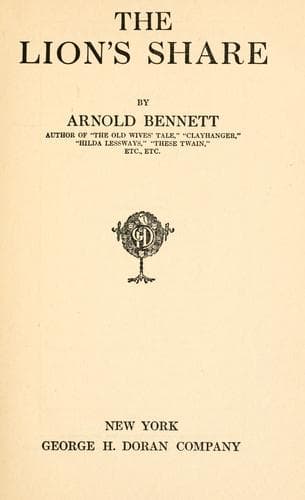
England -- Fiction; Man-woman relationships -- Fiction; Mothers and daughters -- Fiction; Paris (France) -- Fiction; Women -- Fiction
"One's a wedding ring and the other's a mourning ring. I bought them
yesterday at Colchester.... Hsh!" She stilled further exclamations from
Miss Ingate until the men were out of the hall.
"Look here! Quick!" she whispered, hastily unlocking a large hat-case that
was left. And Miss Ingate looked and saw a block toque, entirely unsuitable
for a young girl, and a widow's veil.
"I look bewitching in them," said Audrey, relocking the case.
"But, my child, what does it mean?"
"It means that I'm not silly enough to go to Paris as a girl. I've had more
than enough of being a girl. I'm determined to arrive in Paris as a young
widow. It will be much better in every way, and far easier for you. In
fact, you'll have no chaperoning to do at all. I shall be the chaperon. Now
don't say you won't go, because you will."
"You ought to have told me before."
"No, I oughtn't. Nothing could have been more foolish."
"But who are you the widow of?"
"Hurrah!" cried Audrey. "You are a sport, Winnie! I'll tell you all the
interesting details in the train."
In another minute Aguilar, gloomy and unbending, had received the keys of
Flank Hall, and the procession crunched down the drive on its way to the
station.
CHAPTER VII
THE CIGARETTE GIRL
Audrey did not deem that she had begun truly to live until the next
morning, when they left London, after having passed a night in the Charing
Cross Hotel. During several visits to London in the course of the summer
Audrey had learnt something about the valuelessness of money in a
metropolis chiefly inhabited by people who were positively embarrassed by
their riches. She knew, for example, that money being very plentiful and
stylish hats very rare, large quantities of money had to be given for
infinitesimal quantities of hats. The big and glittering shops were full of
people whose pockets bulged with money which they were obviously anxious to
part with in order to obtain goods, while the proud shop-assistants, secure
in the knowledge that money was naught and goods were everything, did their
utmost, by hauteur and steely negatives, to render any transaction
possible. It was the result of a mysterious "Law of Exchange." She was
aware of this. She had lost her childhood's naive illusions about the
sovereignty of money.
Public-domain text, read in full here on John Shaqi.
Reviews
Reviews
No reviews yet
Be the first to share your thoughts on this work.
Join the Discussion
Join the discussion
Sign in to leave a comment or review.
Sign InorCreate an account