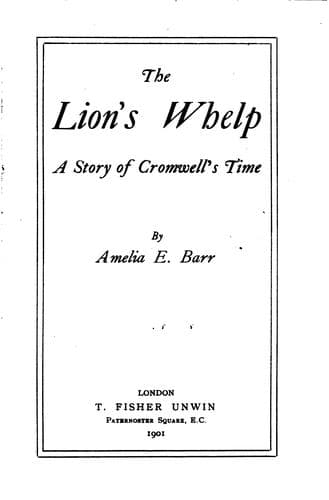
The Lion's Whelp: A Story of Cromwell's TimeBarr, Amelia E.
History
The Lion's Whelp: A Story of Cromwell's Time
Barr, Amelia E.
Great Britain -- History -- Stuarts, 1603-1714 -- Fiction
"At any rate," continued General Swaffham, "Cromwell at this hour owed
nothing to his dress. I have seen him in the fields by St. Ives, and in
Ely Market, in the same kind of clothing. What would you? And what did
it matter? His spirit clothed his flesh, and the power of the spirit
was on him, so that the men in velvet and fine lace wilted away in his
presence."
"No one minds the Lord General’s having power, no one minds giving him
honour for what he has done for England, but the Cromwell women! What
have they done more than others?" asked Mrs. Swaffham.
"Be at peace, Martha," said General Swaffham; "here are things to
consider of far greater import than the Cromwell women. How the nation
will take this affair, remains to be seen. ’Tis true the Lord General
was cheered all through the city, but he knows—and no man better—what a
fickle heart the populace have. As like as not, it will be, as he said
to me, ’Overturn, overturn, and great tasks on all sides.’"
"I look for measureless wrath and vain babble, and threats heard far and
wide," said Doctor Verity. "The people have been given what they
wanted, and twenty to one they will now nay-say all they have roared
for. That would be like the rest of their ways."
For once Doctor Verity was wrong. This master-stroke of Cromwell’s went
straight to the heart of London. "Not a dog barked against it," said
Cromwell to his friends, and he was to all intents and purposes right.
Those who called it "usurpation" confessed that it was an usurpation of
capability, in place of one of incapability. Even the lampoons of the
day were not adverse to Cromwell, while some of them gave him a grim
kind of pleasure.
Thus, one morning, Cluny Neville passing the Parliament House noticed
placards on its walls, and going close enough to read them, found they
advertised "_This house to let; unfurnished_." And when he told this to
Cromwell, that faculty in the man which sometimes made for a rude kind
of mirth, was aroused, and he burst into an uproarious enjoyment of the
joke. "I wish," he cried, "I wish I knew the wag who did it. I would
give him a crown or two, I would indeed, and gladly."
There had been a little uncertainty about the navy, for Sir Harry Vane
had shown it great favour. But Admiral Robert Blake was as great and as
unselfish a man in his office as was Oliver Cromwell. He accepted the
change without dissent, telling his fleet simply—
"It is not the business of seamen to mind state affairs. Our business is
to keep foreigners from fooling us, and to find the Dutch ships, fight
them, and sink them."
Public-domain text, read in full here on John Shaqi.
Reviews
Reviews
No reviews yet
Be the first to share your thoughts on this work.
Elsewhere in the archive
Join the Discussion
Join the discussion
Sign in to leave a comment or review.
Sign InorCreate an account