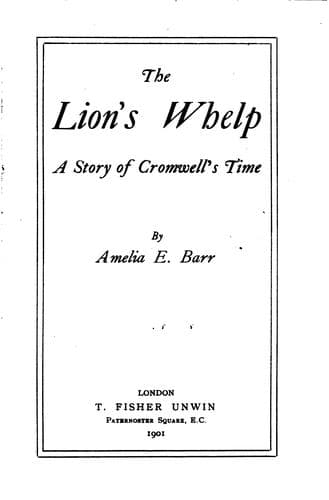
The Lion's Whelp: A Story of Cromwell's TimeBarr, Amelia E.
History
The Lion's Whelp: A Story of Cromwell's Time
Barr, Amelia E.
Great Britain -- History -- Stuarts, 1603-1714 -- Fiction
And yet the feeling which led to Mrs. Swaffham’s little burst of temper
was not particular to herself. Many women felt precisely as Martha
Swaffham did, and Cromwell did not take this element into his
consideration. Yet it was one that worked steadily towards its
reckoning, for men do not finally withstand the ceaseless dropping fire
of their own hearthstones. Mrs. Fleetwood’s and Mrs. Lambert’s
ill-feeling about precedence was indefinitely multiplied, and Mrs.
Swaffham’s more intimate rejection of the Cromwell women was a stone
thrown into water and circling near and far. The Lord General Cromwell,
men and women alike, could accept; he had fought his way to honour, and
they could give him what he had won. But the Cromwell women had done
nothing, and suffered nothing beyond the ordinary lot; it was a much
harder thing to render homage unto them. In these days, Mrs. Swaffham,
though ignoring the late King, was distinctly royal and loyal where
Queen Henrietta Maria was concerned.
But it was, after all, a grand time in old England. Adventures and
victories were the news of every day. Nothing was too strange to happen;
people expected romances and impossibilities; and because they expected
them, they came. The big city was always astir with news; it flew from
lip to lip, like wild fire, was rung out from every steeple, and flashed
in bonfires from one high place to another. This formidable man in
black and gray was at the helm of affairs, and England felt that she
might now trade and sow and marry and be happy to her heart’s desire.
The shutting of the Parliament House affected nothing; the machinery of
Government went on without let or hindrance. A new Parliament was
quickly summoned, one hundred and forty Puritan notables "fearing God
and of approved fidelity and honesty," and it was to begin its sittings
on the ensuing fourth of July. Meantime, Robert Blake was wiping out of
existence the Dutch navy and the Dutch commerce. In the month of June,
he took eleven Dutch men-of-war and one thousand three hundred and fifty
prisoners; the church bells rang joyously from one end of England to the
other, and London gathered at St. Paul’s to sing Te Deums for the
victory.
Public-domain text, read in full here on John Shaqi.
Reviews
Reviews
No reviews yet
Be the first to share your thoughts on this work.
Elsewhere in the archive
Join the Discussion
Join the discussion
Sign in to leave a comment or review.
Sign InorCreate an account