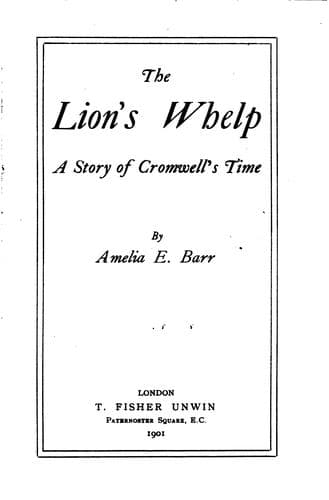
The Lion's Whelp: A Story of Cromwell's TimeBarr, Amelia E.
History
The Lion's Whelp: A Story of Cromwell's Time
Barr, Amelia E.
Great Britain -- History -- Stuarts, 1603-1714 -- Fiction
Thus to the echoes of trumpets and cannon the business of living and
loving went on. The great national events were only chorus to the
dramas and tragedies of the highest and the humblest homes. While
Cromwell was issuing writs for a new Parliament and holding the reins of
Government tightly in his strong hands, his wife and daughters were
happily busy about the marriage of young Harry Cromwell to Elizabeth
Russel; and Sir Peter Lely was painting their portraits, and Lady Mary
Cromwell had her first lover; and Mrs. Swaffham was making the cowslip
wine; and the Fermor and Heneage girls off to Bath for trifling and
bathing and idle diversions; and Jane sewing the sweetest and tenderest
thoughts into the fine linen and cambric which she was fashioning into
garments for her own marriage. In every family circle it was the same
thing: the little comedies of life went on, whether Parliament sat or
not, whether Blake brought in prizes, or lay watching in the Channel;
for, after all, what the people really wanted was peace and leisure to
attend to their own affairs.
One lovely morning in this jubilant English spring, Jane sat at the open
window writing to Matilda de Wick. All the sweet fresh things of the
earth and the air were around her, but she was the sweetest and freshest
of all. There was a pleasant smile on her lips as her fingers moved
across the white paper. She was telling her friend about Harry
Cromwell’s marriage in the old church at Kensington; about the dresses
and the wedding feast, and the delightful way in which the Lord General
had taken his new daughter to his heart. "And what now will Mistress
Dorothy Osborne do?" she asked. "To be sure, she is said to be greatly
taken with Sir William Temple, who is of her own way of thinking—which
Harry Cromwell is not, though Mrs. Hutchinson has spoken of him
everywhere as a ’debauched, ungodly cavalier;’ but Mrs. Hutchinson has a
Presbyterian hatred of the Cromwells. And I must also tell you that the
Lords Chandos and Arundel have been tried before the Upper Bench for the
killing of Mr. Compton in a duel. The crime was found manslaughter, and
they were sentenced to be burned in the hand which was done to them
both, but very favourably. And the Earl of Leicester said he was glad
of it, for it argued a good stiff government to punish men of such high
birth; but my father thinks Leicester to be the greatest of levelers, he
would abolish all rank and titles but his own. And I must also tell you
that General Monk has discovered his marriage to Ann Clarges a
market-woman of low birth, no beauty whatever, and a very ill tongue.
My mother is sure the General must have been bewitched; however,
Mistress Monk has gone to live in Greenwich palace, which has been given
to the General for a residence. And the rest of my news is in a
nutshell, Matilda. I heard from Tonbert that your brother had been seen
at de Wick, but this I discredit. Did he not go with you to France:
Public-domain text, read in full here on John Shaqi.
Reviews
Reviews
No reviews yet
Be the first to share your thoughts on this work.
Elsewhere in the archive
Join the Discussion
Join the discussion
Sign in to leave a comment or review.
Sign InorCreate an account