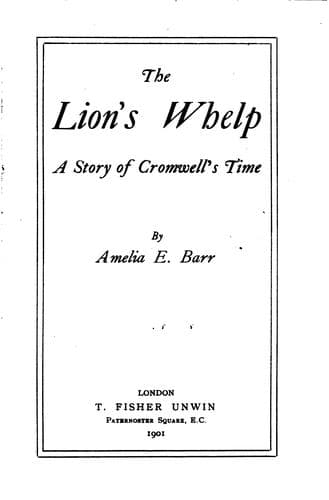
The Lion's Whelp: A Story of Cromwell's TimeBarr, Amelia E.
History
The Lion's Whelp: A Story of Cromwell's Time
Barr, Amelia E.
Great Britain -- History -- Stuarts, 1603-1714 -- Fiction
But Cluny could not make the change proposed without some delay, his
papers and jewels being bestowed in his saddle linings. So with a good
wish the two men parted, and there was no anger between them;—admiration
and good will had taken its place. Neville hastened forward, as he had
been advised, and Rupert returned to Paris. He knew Matilda was
expecting him, and he pictured to himself her disappointment and anxiety
at his non-appearance; it was also her last evening in Paris, and it
grieved him to miss precious hours of love, that might never be given
him again. Yet he was physically exhausted, and as soon as he threw
himself upon a couch he forgot all his weariness and all his anxieties
in a deep sleep.
Matilda was not so happy as to find this oblivion. She knew over what
social pitfalls every man of prominence in Paris walked—in the King’s
favour one day, in the Bastile the next day—and that this very
insecurity of all good things made men reckless. Rupert might have
offended King Louis or the great Cardinal. She imagined a hundred
causes for flight or fight or imprisonment; she recalled one story after
another of nobles and gentlemen seen flourishing in the presence of
Louis one day and then never seen again. She knew that plots and
counterplots, party feuds and family hatreds, were everywhere rife; and
that Rupert was rash and outspoken, and had many enemies among the
courtiers of Louis and the exiled nobles of England, not to speak of the
Commonwealth spies, to whom he was an object of superstitious hatred,
who regarded his blackamoors as familiar spirits, and believed firmly
that "he had a devil," and worked evil charms by the devil’s help and
advice. And above all, and through these sad forebodings, there was the
ever present likelihood of a duel. Every man had sword in hand, ready
to settle some terrible or trivial quarrel—though it did not require a
quarrel to provoke the duel; men fought for a word, for a sign, for the
colour of a ribbon, for nothing at all, for the pleasure of killing
themselves to kill time.
Matilda was keenly alive to all these possible tragedies, and when her
lover failed to keep what was likely to be their last tryst, she was
more frightened than angry; yet when Rupert came at an exceptionally
early hour in the morning, and she saw him safe and well, her anxiety
became flavoured with displeasure.
"How could you so cruelly disappoint me?" she cried. "You see now that
our time is nearly gone; in a few hours we must part, perhaps forever."
"My dearest, loveliest Mata, I was about your pleasure. I was following
Lord Neville, and he took me further than I expected. When my business
was done with him, I had twenty miles to ride back to Paris; and I
confess to you, I was so weary that I could only sleep. In your love,
remember how lately I have been sick to death."
"Lord Neville again! The man is an incubus. Why did you follow him?"
Public-domain text, read in full here on John Shaqi.
Reviews
Reviews
No reviews yet
Be the first to share your thoughts on this work.
Elsewhere in the archive
Join the Discussion
Join the discussion
Sign in to leave a comment or review.
Sign InorCreate an account