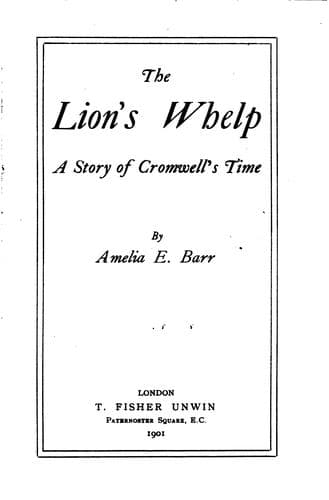
The Lion's Whelp: A Story of Cromwell's TimeBarr, Amelia E.
History
The Lion's Whelp: A Story of Cromwell's Time
Barr, Amelia E.
Great Britain -- History -- Stuarts, 1603-1714 -- Fiction
"You wished me to give him a lesson. He was going homeward. I had to
ride last night, or let him escape. By my troth, I had only your
pleasure in mind."
"Oh, but the price paid was too great! I had to give up your society
for hours. That is a loss I shall mourn to the end of my life. I hope,
then, that you killed him. Nothing less will suffice for it."
"I was out of fortune, as I always am. I had an accident, and was at
his mercy. He gave me my life."
"Now, indeed, you pierce my heart. You at his mercy! It is an
intolerable shame! It will make me cry out, even when I sleep! I shall
die of it. You! You! to be at his mercy—at the mercy of that Puritan
braggart. Oh, I cannot endure it!"
"You see that I endure it very complacently, Mata. The man behaved as a
gentleman and a soldier. I have even taken a liking to him. I have
also paid back his kindness; we are quits, and as soldiers, friends. It
was an accident, and as Neville very piously said, ’Accidents are God’s
part in an affair;’ and therefore we would not be found fighting against
God. You know, Mata, that I have been very religiously brought up. And
I can assure you no one’s honour suffered, mine least of all."
But Matilda was hard to comfort. Her last interview with her lover was
saddened and troubled by this disagreement; and though both were
broken-hearted in the moments of farewell, Matilda, watching Rupert
across the Place Royale, discovered in the listless impatience of his
attitude and movements, that inward revolt against outward strife,
which, if it had found a voice, would have ejaculated, "I am glad it is
over."
This, then, was the end of the visit from which she had expected so
much; and one sad gray morning in November they reached London. Sir
Thomas was like a man released from a spell, and he went about his house
and garden in a mood so happy that it was like a psalm of gratitude to
be with him. Lady Jevery was equally pleased, though less ready to show
her pleasure; but to Matilda, life appeared without hope—a state of
simple endurance, for she had no vital expectation that the morrow, or
any other morrow, would bring her happiness.
The apparently fateful interference of Neville in her affairs made her
miserable. She thought him her evil genius, the bearer of bad news, the
bringer of sorrow. She felt Rupert’s "accident" as part of the bad
fate. She had been taught fencing, and Cymlin Swaffham had often
declared her a match for any swordsman, so that she knew, as well as
Rupert knew, no honour had been lost between him and Neville. But the
"accident" touched her deeper than this: she regarded it as a proof that
the stars were still against her good fortune, separating her from her
lover, influencing Neville and his party for victory, and dooming the
King and his party to defeat in all their relationships, private and
national.
Public-domain text, read in full here on John Shaqi.
Reviews
Reviews
No reviews yet
Be the first to share your thoughts on this work.
Elsewhere in the archive
Join the Discussion
Join the discussion
Sign in to leave a comment or review.
Sign InorCreate an account