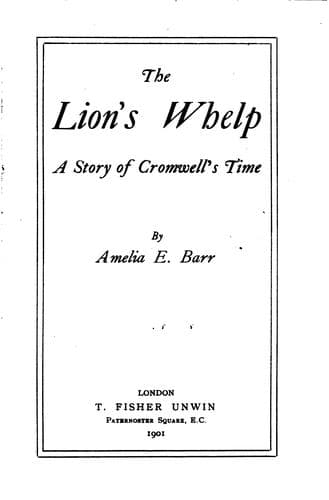
The Lion's Whelp: A Story of Cromwell's TimeBarr, Amelia E.
History
The Lion's Whelp: A Story of Cromwell's Time
Barr, Amelia E.
Great Britain -- History -- Stuarts, 1603-1714 -- Fiction
She said to herself in the first hours of her return that she would not
see Jane, but as the day wore on she changed her mind. She wished to
write Rupert every particular about national events, and she could best
feel the Puritan pulse through Jane; while from no one else could she
obtain a knowledge of the household doings of Cromwell and his family.
Then, also, she wished Jane to see her new dresses, and to hear of the
great and famous people she had been living among. What was the use of
being familiar with princesses, if there was no one to talk to about
them? And Matilda had so much to say concerning the ex-Queen of Bohemia
and her clever daughters, that she could not deny herself the society of
Jane as a listener. So she wrote and asked her to come, and Jane
answered the request in person, at once. This hurry of welcome was a
little malapropos. Matilda had not assumed the dress and style she had
intended, and the litter of fine clothing about her rooms, and the
partially unpacked boxes, gave to her surroundings an undignified and
unimpressive character. But friendship gives up its forms tardily;
people kiss each other and say fond words long after the love that ought
to vitalise such symbols is dead and buried; and for awhile the two
girls did believe themselves glad to meet again. There were a score of
things delightful to women over which they could agree, and Jane’s
admiration for her friend’s beautiful gowns and laces and jewels, and
her interest in Matilda’s descriptions of the circumstances in which
they were worn, was so genuine, that Matilda had forgotten her relation
to Lord Neville, when the irritating name was mentioned.
"Did you see Lord Neville in Paris?" Jane asked; and there was a wistful
anxiety in her voice to which Matilda ought to have responded. But the
question came when she was tired even of her own splendours and
successes; she had talked herself out, and was not inclined to continue
conversation if the subject of it was to be one so disagreeable. "No,"
she answered sharply. "I did not see him. He called one day, and had a
long talk with Sir Thomas, but aunt had a headache, and I had more
delightful company."
"I thought for my sake you would see him. Did you hear anything of his
affairs?"
"Indeed, I heard he gave great offense to Cardinal Mazarin by his
authoritative manner."
"_Oh!_"
"You know, Jane, that he has a most presuming, haughty way? He has!"
"I am sure he has not, Matilda."
"Every one wondered at Cromwell sending a mere boy on such delicate and
important business. It was considered almost an insult to Mazarin."
"How can you say such things, Matilda? The business was neither
delicate nor important. It was merely to deliver a parcel to Mazarin.
Cluny was not charged with any explanations, and I am sure he took
nothing on himself."
"I only repeat what I heard—that he carried himself as if he were a
young Atlas, and had England’s fate and honour on his shoulders."
Public-domain text, read in full here on John Shaqi.
Reviews
Reviews
No reviews yet
Be the first to share your thoughts on this work.
Elsewhere in the archive
Join the Discussion
Join the discussion
Sign in to leave a comment or review.
Sign InorCreate an account