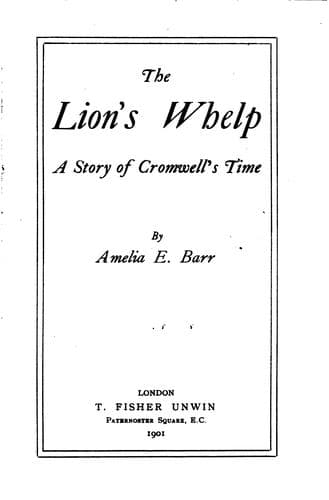
The Lion's Whelp: A Story of Cromwell's TimeBarr, Amelia E.
History
The Lion's Whelp: A Story of Cromwell's Time
Barr, Amelia E.
Great Britain -- History -- Stuarts, 1603-1714 -- Fiction
"Why do people marry and bring up sons and daughters? This girl has been
loved to the uttermost by her father and mother and brothers, and she
will gladly leave them all to go off with this young Scot. She will
call it ’Sacrifice for Love’s sake;’ I call it pure selfishness. Yet I
am not a whit whiter than she. I would have stayed in Paris with
Rupert, though my good uncle was in danger. How dreadful it is to look
into one’s own soul, and make one’s self tell it the honest truth. I
think I will go to my evening service;" and as she rose for her Common
Prayer, she was saying under her breath, "We have left undone those
things which we ought to have done, and we have done those things which
we ought not to have done. And there is no health in us."
Lady Jevery had a dinner party that night, and Matilda went down to it
in considerable splendour. Doctor Hewitt was present, and Mr. Waller,
the poet, and Denzil Hollis, and the witty, delightful Henry Marten, and
Matilda’s great favourite, the little royalist linen draper, Izaak
Walton, whose _Complete Angler_ had just been published. He had brought
Sir Thomas a copy of it, and Matilda found out at once the song, "Come
live with me and be my love." Her praises were very pleasant to the old
man, who had hid Donne and Hooker and Herbert in his Inner Chamber
during the days of the Long Parliament; who had been the friend of
bishops Ken and Sanderson, and of archbishops Usher and Sheldon; and
who, born in Elizabeth’s reign, had lived to see "Sceptre and Crown
tumbled down."
"But you are not the only author of Great Oliver’s reign," she said with
a whimsical smile. "This day Mistress Dorothy Osborne sent me a copy of
the poems of my Lady Newcastle. She has been making herself still more
absurd than she is by writing a book—and in verse. ’Sure,’ said
Mistress Dorothy to me, ’if I did not sleep for a month, I should never
come to that point.’ Why does her husband let her run loose? I vow
there are soberer people in Bedlam."
"Her husband adores her; he believes her to be a prodigy of learning."
"They are a couple of fools well met. I am sorry for them. She dashes
at everything, and he goes about trumpeting her praises. Come, sir, I
hear the company tossing Cromwell’s name about. Let us join the
combatants; I wish to be in the fray."
Public-domain text, read in full here on John Shaqi.
Reviews
Reviews
No reviews yet
Be the first to share your thoughts on this work.
Elsewhere in the archive
Join the Discussion
Join the discussion
Sign in to leave a comment or review.
Sign InorCreate an account