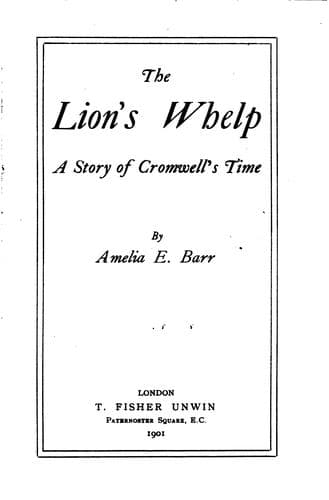
The Lion's Whelp: A Story of Cromwell's TimeBarr, Amelia E.
History
The Lion's Whelp: A Story of Cromwell's Time
Barr, Amelia E.
Great Britain -- History -- Stuarts, 1603-1714 -- Fiction
The fact was Sir Thomas had asked after political affairs since he left
England in April, and there was plenty of material for discussion.
Denzil Hollis was describing the opening of the Parliament summoned by
Cromwell, and which met on the fourth of July. "He made to this
Parliament," he said, "a wonderful speech. He declared that he ’did not
want supreme power, no, not for a day, but to put it into the hands of
proper persons elected by the people.’ And he bid them ’be humble and
not consider themselves too much of a Parliament.’ And then he burst
into such a strain as none ever heard, taking texts from psalms, and
prophets and epistles, mingled with homely counsels, and entreaties to
them to do their duty—speaking till the words fell red hot from his
lips, so that when he ended with the psalm on Dunbar field we were all
ready to sing it with him; for as he told us, with a shining face, ’the
triumph of the psalm is exceeding high and great, and God is now
accomplishing it.’"
"No English Parliament was ever opened like that," said Sir Thomas.
"Has it done anything yet?"
"It has done too much. It has committees at work looking into the
affairs of Scotland and Ireland, the navy, the army and the law. They
have been through the jails, and set three hundred poor debtors free in
London alone. They have abolished titles and the Court of Chancery; and
the last two acts have made the nation very uneasy. Upon my honour, the
people are more unhappy at getting rid of their wrongs than you would
credit."
"Englishmen like something to grumble about," said Mr. Walton. "If the
Commonwealth leaves them without a grievance, it will doom itself."
"That is not it, Mr. Walton," said Henry Marten; "Englishmen don’t like
the foundations destroyed in order to repair the house. Going over
precipices is not making progress. You may take it for an axiom that as
a people, we prefer abuses to novelties."
"The reign of the saints is now begun," said Doctor Hewitt scornfully;
"and Sir Harry Vane is afraid of what he has prayed for. He has gone
into retirement, and sent Cromwell word he would wait for his place
until he got to heaven."
"Sir Harry is not one of Zebedee’s sons."
"This Parliament is going too fast."
"They have no precedents to hamper them."
"Everything old is in danger of being abolished."
"They talk of reducing all taxation to one assessment on land and
property. Absurd!"
"Some say they will burn the records in the Tower; and the law of Moses
is to take the place of the law of England."
"And the Jews are to have civil rights."
"And after that we may have a Jewish Sanhedrim in place of a Puritan
Parliament."
"The good people of England will never bear such innovations," said Sir
Thomas with great indignation.
"None of us know how much the good people of England will bear,"
answered Hollis.
"And pray what part does Cromwell take in these changes? Surely he is
the leader of them?" asked Lady Jevery.
Public-domain text, read in full here on John Shaqi.
Reviews
Reviews
No reviews yet
Be the first to share your thoughts on this work.
Elsewhere in the archive
Join the Discussion
Join the discussion
Sign in to leave a comment or review.
Sign InorCreate an account