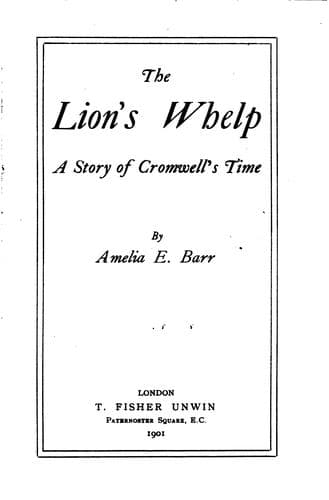
The Lion's Whelp: A Story of Cromwell's TimeBarr, Amelia E.
History
The Lion's Whelp: A Story of Cromwell's Time
Barr, Amelia E.
Great Britain -- History -- Stuarts, 1603-1714 -- Fiction
"Yes! Yes! But I am a wife and a mother, and you know not yet what
that means, Jane. All day I have been saying—no matter what my hands
were doing—let this cup pass me, Lord. If your father fell!—if John, or
Cymlin, or Tonbert were left on the battle-field! Oh, Jane! Jane!" and
the terror that had haunted her all day and shown itself in an
irrepressible fretfulness, now sought relief in tears and sobbing. Jane
kissed and comforted the sorrowful woman. She led her up-stairs, and
helped her into the sanctuary of sleep by many brave and hopeful words;
and it so happened that she finally uttered a promise that had once been
given to the anxious wife and mother, as a sacred secret token of help
and deliverance. And when she heard the gracious words dropping from
Jane’s lips she said—"That is sufficient. Once, when I was in great
fear for your father, the Lord gave me that assurance; now He sends it
by you. I am satisfied. I will lay me down and sleep; the words will
sing in my heart all night long," and she said them softly as Jane
kissed her—"’From the beginning of our journey, the Lord delivered us
from every enemy.’"
Then Jane went to her own room. It was a large, low room on the morning
side of the house, and it was an illustration of the girl—a place of
wide, free spaces, and no furniture in it that was for mere ornament—a
small tent bed draped with white dimity, a dressing-table equally plain
and spotless, a stand on which lay her Bible, a large oak chair of
unknown age, and two or three chairs of the simplest form made of
plaited rushes and willow wands. Some pots of sweet basil and geranium
were in the casements, and the place was permeated with a peace and
perfume that is indescribable.
To this sweet retreat Jane went with eager steps. She closed the door,
slipped the iron bolt into its place, and then lit a rush candle. The
light was dim, but sufficient. In it she disrobed herself, and loosened
the long braids of pale brown hair; then she put out the candle and let
the moonlight flood the room, make whiter the white draperies, and add
the last ravishing touch of something heavenly, and something apart from
the sphere of our unrest and sorrow.
For some time she sat voiceless, motionless. Was she dreaming of
happiness, or learning to suffer? Neither, consciously; she was
"waiting" on the Eternal, waiting for that desire God Himself forms in
the soul—that secret voice that draws down mercies and spiritual favours
which no one knoweth but they who receive them. And Jane was well aware
that it was only in the serene depth of a quiescent will she could rise
above the meanness of fear and the selfishness of hope, and present that
acceptable prayer which would be omnipotent with God:—omnipotent,
because so wonderfully aided by all those strange things and secret
decrees and unrevealed transactions which are beyond the stars; but
which all combine in ministry with the praying soul.
Public-domain text, read in full here on John Shaqi.
Reviews
Reviews
No reviews yet
Be the first to share your thoughts on this work.
Join the Discussion
Join the discussion
Sign in to leave a comment or review.
Sign InorCreate an account