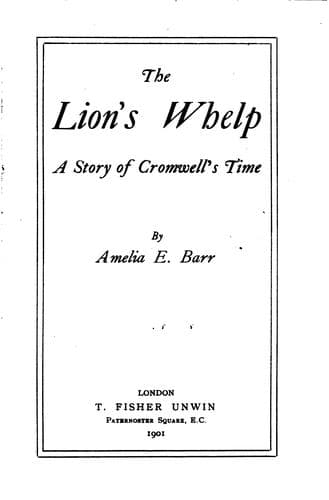
The Lion's Whelp: A Story of Cromwell's TimeBarr, Amelia E.
History
The Lion's Whelp: A Story of Cromwell's Time
Barr, Amelia E.
Great Britain -- History -- Stuarts, 1603-1714 -- Fiction
"They were the wives of the sailor men going with our Admiral on his
expedition. And they got all round me, they did indeed; and one
handsome woman with a little lad in her arms—she told me to look well at
him because he was called Oliver after me—took hold of my bridle, and
said, ’You won’t trample me down, General, for the lad’s sake; and ’tis
but natural for us to want to know where you are sending our husbands.
Come, General, tell us wives and mothers where the ships are going to?’
And there was Robert Blake laughing and thinking it fine sport, but I
stood up in my stirrups and called out as loud as I could, ’Women, can
you be quiet for one minute?’ They said, ’Aye, to be sure we can, if
you’ll speak out, General.’ Then I said to them, ’You want to know
where the ships and your men are going. Listen to me! The Ambassadors
of France and Spain would, each of them, give a million pounds to know
that. Do you understand, women?’ And for a moment there was a dead
silence, then a shout of comprehension and laughter, and the woman at my
bridle lifted the boy Oliver to me, and I took him in my arms and kissed
the rosy little brat, and then another shout, and the mother said,
’General, you be right welcome to my share of the secret;’ ’and mine!’
’and mine!’ ’and mine!’ they all shouted, and the voices of those women
went to my heart and brain like wine, they did that. They made me glad;
I believe I shouted with them."
"I haven’t a doubt of it," said Doctor Verity. "Well, Robert, did they
have nothing to say to you?" he asked, turning to Admiral Blake.
"They asked me to treat my men well; and I said, ’I’ll treat them like
myself. I’ll give them plenty of meat and drink, and plenty of fighting
and prize money;’ and so to their good will we passed all through the
city, and, as I live, ’twas the pleasantest ’progress’ any mortal men
could desire."
Then Doctor Verity began to talk of the American Colonies, and their
wonderful growth. "John Maidstone is here," he said; "and with him that
godly minister, the Rev. Mr. Hooker. We have had much conversation
to-day, and surely God made the New World to comfort the woes of the old
one."
"You have expressed exactly, sir, the prophetic lines of the pagan poet,
Horace," answered Mr. Milton. And Cromwell looked at him and said,
"Repeat them for us, John; I doubt not but they are worthy, if it be so
that you remember them." Then Milton, in a clear and stately manner,
recited the six lines from Horace’s "Patriotic Lament" to which he had
referred—
"’Merciful gift of a relenting God,
Home of the homeless, preordained for you,
Last vestige of the age of gold,
Last refuge of the good and bold;
From stars malign, from plague and tempests free,
Far ’mid the Western waves, a secret Sanctuary.’"
And as Cromwell listened his face grew luminous; he seemed to look
through his eyeballs, rather than with them, and when Milton ceased
there was silence until he spoke.
Public-domain text, read in full here on John Shaqi.
Reviews
Reviews
No reviews yet
Be the first to share your thoughts on this work.
Elsewhere in the archive
Join the Discussion
Join the discussion
Sign in to leave a comment or review.
Sign InorCreate an account