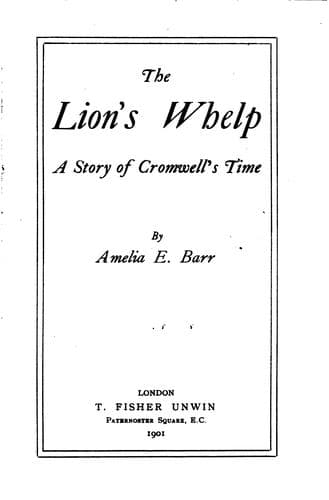
The Lion's Whelp: A Story of Cromwell's TimeBarr, Amelia E.
History
The Lion's Whelp: A Story of Cromwell's Time
Barr, Amelia E.
Great Britain -- History -- Stuarts, 1603-1714 -- Fiction
"I see," he said, "a great people, a vast empire, from the loins of all
nations it shall spring. And there shall be no king there. But the
desire of all hearts shall be towards it, and it shall be a covert for
the oppressed, and bread and wine and meat for those ready to perish."
Then, sighing, he seemed to realise the near and the present, and he
added, "’Twas but yesterday I wrote to that good man, the Rev. John
Cotton of Boston. I have told him that I am truly ready to serve him
and the rest of the brethren, and the churches with him. And Doctor
Verity, I wish much to have some talk with Mr. Hooker. I have a purpose
to ask him to be my chaplain, if he be so minded, for his sermons first
taught me that I had a soul to save, and that I must transact that
business directly with God, and not through any church or clergy." And
when Cromwell made this statement, he little realised that Hooker,
founding a democracy in America, and he himself fighting for a free
Parliament and a constitutionally limited executive in England, were
"both of them of the same spirit and purpose"; and that the Hartford
minister and the Huntingdon gentleman were preeminently the leaders in
that great movement of the seventeenth century which made the United
States, and is now transforming England.
Doctor Verity shook his head at the mention of the Chaplainship. "Your
Highness will give great offense to some not of Mr. Hooker’s precise way
of thinking," he said.
"I care not, John Verity," Oliver answered with much warmth; "one creed
must not trample upon the heels of another creed; Independents must not
despise those under baptism, and revile them. I will not suffer it.
Even to Quakers, we must wish no more harm than we do our own souls."
With these words he rose from the table, and Mr. Milton, the Ladies Mary
and Frances Cromwell, and Jane Swaffham went into the great hall, where
there was an exceedingly fine organ. In a short time Mr. Milton began
to play and to sing, but the girls walked up and down talking to Jane of
their admirers, and their new gowns, and of love-letters that had been
sent them in baskets of flowers. And what song can equal the one we
sing, or talk, about our own affairs? Mr. Milton’s glorious voice rose
and fell to incomparable melodies, but Jane’s hand-clasp was so
friendlike, and her face and words so sympathetic, that the two girls
heard only their own chatter, and knew not that the greatest of English
poets was singing with enchanting sweetness the songs of Lodge, and
Raleigh, and Drayton.
But Cromwell knew it; he came to the entrance frequently and listened,
and then went back to the group by the hearth, who were smoking and
talking of the glorious liberating movements of the century—the
Commonwealth in England, and the free commonwealths Englishmen were
planting beyond the great seas. If the first should fail, there would
still be left to unslavish souls the freedom of the illimitable western
wilderness.
Public-domain text, read in full here on John Shaqi.
Reviews
Reviews
No reviews yet
Be the first to share your thoughts on this work.
Elsewhere in the archive
Join the Discussion
Join the discussion
Sign in to leave a comment or review.
Sign InorCreate an account