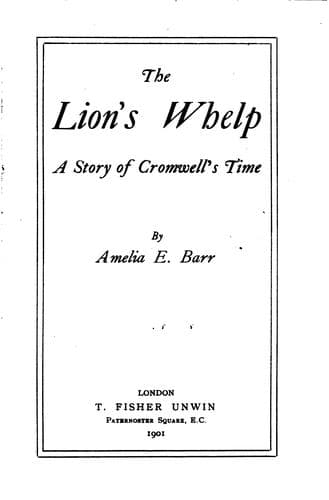
The Lion's Whelp: A Story of Cromwell's TimeBarr, Amelia E.
History
The Lion's Whelp: A Story of Cromwell's Time
Barr, Amelia E.
Great Britain -- History -- Stuarts, 1603-1714 -- Fiction
In the meantime Spain was helping Charles with money which was spent in
plots to assassinate the Protector. The effect of this underhand,
contemptible warfare was several petitions and addresses offered in
Parliament begging Cromwell to assume the ancient office of King, if
only for the settlement of the nation. He was quite strong enough to
have taken it, and there was nothing unmanly either in his desire for
the crown or in his refusal of it. His conscience, not his reason,
decided the question. He waited many a long, anxious night on his knees
for some sign or token of God’s approbation of the kingship, but it did
not come; and Cromwell was never greater than when, steadily, and with
dignity, he put the glittering bauble aside—"Because for it, he would
not lose a friend, or even a servant." He told the Parliamentary
committee offering him the title that he "held it as a feather in a
man’s cap;" then burst into an inspired strain, and quoting Luther’s
psalm, "that rare psalm for a Christian," he added, "if Pope and
Spaniard and devil set themselves against us, yet the Lord of Hosts is
with us, and the God of Jacob is our refuge." One thing he knew well,
that the title of King would take all meaning out of the Puritan
revolution, and he could not so break with his own past, with his own
spiritual life, and with the godly men who had so faithfully followed
and so fully trusted him.
Why should he fret himself about a mere word? All real power was in his
hands: the army and the navy, the churches and the universities, the
reform and administration of the law, the government of Scotland and of
Ireland. Abroad, the war with all its details, the alliance with Sweden,
with France, with the Protestant princes of Germany, the Protestant
Protectorate extending as far as Transylvania, the "planting" of the
West Indies, the settlement of the American Colonies, and their defense
against their rivals, the French,—all these subjects were Cromwell’s
daily cares. He was responsible for everything, and his burden would
have been lightened, if he could have conscientiously taken on him the
"divinity which doth hedge a king." The English people love what they
know, and they knew nothing of an armed Protector making laws by
ordinance, and disposing of events by rules not followed by their
ancestors. But Oliver knew that he would cross Destiny if he made
himself King, and that this "crossing" always means crucifixion of some
kind.
"To be a king is not in my commission," he said to Doctor Verity. "It
squares not with my call or my conscience. I will not fadge with the
question again; no, not for an hour."
Public-domain text, read in full here on John Shaqi.
Reviews
Reviews
No reviews yet
Be the first to share your thoughts on this work.
Elsewhere in the archive
Join the Discussion
Join the discussion
Sign in to leave a comment or review.
Sign InorCreate an account