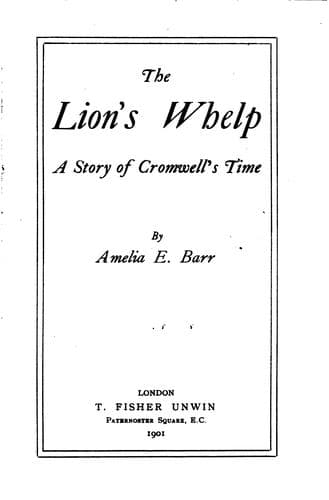
The Lion's Whelp: A Story of Cromwell's TimeBarr, Amelia E.
History
The Lion's Whelp: A Story of Cromwell's Time
Barr, Amelia E.
Great Britain -- History -- Stuarts, 1603-1714 -- Fiction
The commercial and national glory of England at this time were, however,
in a manner incidental to Oliver’s great object—the Protection of
Protestantism. This object was the apple of his eye, the profoundest
desire of his soul. He would have put himself at the head of all the
Protestants in Europe, if he could have united them; failing in this
effort, he vowed himself to cripple the evil authority of Rome and the
bloody hands of Inquisitorial Spain. His sincerity is beyond all doubt;
even Lingard, the Roman Catholic historian, says, "Dissembling in
religion is contradicted by the uniform tenor of his life." He wrote to
Blake that, "The Lord had a controversy with the Romish Babylon, of
which Spain is the under-propper;" and he made it his great business to
keep guard over Protestants, and to put it out of the power of princes
to persecute them. It is easy to say such a Protestant league was
behind the age. It was not. Had it been secured, the persecutions of
the Huguenots would not have taken place, and the history of those
hapless martyrs—still, after the lapse of two hundred years, read with
shuddering indignation—would have been very different. Cromwell knew
well what Popery had done to Brandeburg and Denmark, and what a
wilderness it had made of Protestant Germany, and his conception of duty
as Protector of all Protestants was at least a noble one. Nor was it
ineffective. On the very day he should have signed a treaty of alliance
with France against Spain, he heard of the unspeakably cruel massacre of
the Vandois Protestants. He threw the treaty passionately aside, and
refused to negotiate further until Louis and Mazarin put a stop to the
brutalities of the Duke of Savoy. As the details were told him, he
wept; and all England wept with him. Not since the appalling massacre
of Protestants in Ireland, had the country been so moved and so
indignant. Cromwell instantly gave two thousand pounds for the
sufferers who had escaped, and one hundred and forty thousand pounds was
collected in England for the same purpose. It was during the sorrowful
excitement of this time that Milton—now blind—wrote his magnificent
Sonnet,
"Avenge, O Lord, Thy slaughtered saints, whose bones
Lie scattered on the Alpine Mountains cold."
Furthermore, it was in Milton’s luminous, majestic Latin prose that
Cromwell sent his demands to King Louis for these poor, pious
peasants,—demands not disregarded, for all that could be found alive
were returned to their desolated homes.
Public-domain text, read in full here on John Shaqi.
Reviews
Reviews
No reviews yet
Be the first to share your thoughts on this work.
Elsewhere in the archive
Join the Discussion
Join the discussion
Sign in to leave a comment or review.
Sign InorCreate an account