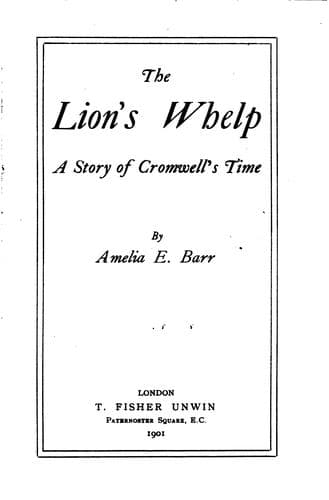
The Lion's Whelp: A Story of Cromwell's TimeBarr, Amelia E.
History
The Lion's Whelp: A Story of Cromwell's Time
Barr, Amelia E.
Great Britain -- History -- Stuarts, 1603-1714 -- Fiction
For the persecuted Jews his efforts were not as successful. They had
been banished from England in A.D. 1290, but three hundred and
sixty-five years of obstinate prejudice had not exhausted Christian
bigotry. Cromwell made a noble speech in favour of their return to
England, but the learned divines and lawyers came forward to "plead and
conclude" against their admission, and Cromwell, seeing no legal
sanction was possible, let the matter drop for a time. Yet his favour
towards the Jews was so distinct that a company of Oriental Jewish
priests came to England to investigate the Protector’s genealogy, hoping
to find in him "the Lion of the tribe of Judah."
So these three years were full of glory and romance, and the poorest
family in England lived through an epic of such national grandeur as few
generations have witnessed. Yet, amid it all, the simple domestic lives
of men and women went calmly on, and birth, marriage, and death made
rich or barren their homes. Jane Swaffham attained in their progress to
a serene content she had once thought impossible. But God has appointed
Time to console the greatest afflictions, and she had long been able to
think of Cluny—not as lying in a bloody grave, but as one of the Sons of
God among the Hosts of Heaven. And this consolation accepted, she had
begun to study Latin and mathematics with Doctor Verity, and to give her
love and her service to all whom she could pleasure or help. Indeed,
she had almost lived with the Ladies Mary and Frances Cromwell, who had
passed through much annoyance and suffering concerning their love
affairs. But these were now happily settled, Lady Mary having married
Viscount Fanconburg, and Lady Frances the lover for whom she had so
stubbornly held out—Mr. Rich, the grandson of the Earl of Warwick.
Matilda’s life during this interval had been cramped and saddened by the
inheritance from her previous years. Really loving Cymlin, she could not
disentangle the many threads binding her to the old unfortunate passion,
for, having become wealthy, the Stuarts would not resign their claim
upon her. Never had they needed money more; and most of their old
friends had been denuded, or worn out with the never-ceasing demands on
their affection. Thus she was compelled, often against her will, to be
aware of plots for the assassination of Cromwell—plots which shocked her
moral sense, and which generally seemed to her intelligence exceedingly
foolish and useless. These things made her restless and unhappy, for she
could not but contrast the splendour of the Protector’s character and
government with the selfishness, meanness and incapacity of the Stuarts.
Public-domain text, read in full here on John Shaqi.
Reviews
Reviews
No reviews yet
Be the first to share your thoughts on this work.
Elsewhere in the archive
Join the Discussion
Join the discussion
Sign in to leave a comment or review.
Sign InorCreate an account