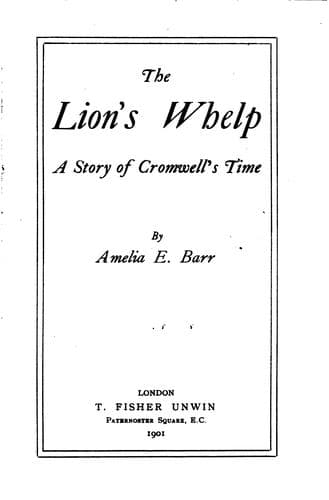
The Lion's Whelp: A Story of Cromwell's TimeBarr, Amelia E.
History
The Lion's Whelp: A Story of Cromwell's Time
Barr, Amelia E.
Great Britain -- History -- Stuarts, 1603-1714 -- Fiction
He was right; it was too heavy a burden for any one man, and the burden
was made still more heavy by his family afflictions. His beloved mother
had left him, gone the way of all the earth, saying with her last
breath, "I leave my heart with thee, dear son! a good-night!" His
son-in-law, Rich, the three months’ bridegroom of his "little Frankie,"
was but a few weeks dead, and the Earl of Warwick, his firmest friend
among the nobility, was dying. His favourite daughter, Elizabeth, was
very ill, and he himself was feeling unmistakable premonitions of his
dissolution. For, day by day, his soul was freeing itself from the
ligaments of the body, rising into a finer air, seeing right and wrong
with the eyes of immortality. But he would do his duty to the last
tittle of strength,—fall battling for the right,—and as to what should
come after, God would care for that.
The fifteenth of May had been set for his assassination. On that day,
risings were to take place in Yorkshire and Sussex; London was to be set
on fire, the Protector seized and murdered, and Charles Stuart land on
the southern coast. Cromwell knew all the secret plans of this
conspiracy of "_The Sealed Knot_"; knew every member of it; and on the
afternoon when Jane Swaffham saw him passing up London streets, so stern
and scornful, he had just ordered the arrest of one hundred of them.
From these he selected fifteen for trial. They were all Royalists; he
would not lay his hand on his old friends, or on any who had once served
the Cause. His mercy and his great heart were never so conspicuous as
at this time. Only two of the fifteen were condemned to death, Doctor
Hewitt, an Episcopal minister, and Sir Henry Slingsby, the uncle of Lord
Fanconbridge, who was the husband of his own daughter, Mary;—Doctor
Hewitt for issuing commissions in Charles Stuart’s name, and Sir Henry
Slingsby for endeavouring to bribe the city of Hull to open its gates to
the Stuart invaders. Against Doctor Hewitt his anger burned with
unusual severity; he would listen to no intercession for him; for, he
said,
"The man has eat my bread, and sat on my hearth, and been a familiar
friend of my family. He has been in all our confidences; he has dipped
his sop in our dish, and cried ’Hail, master’ to me. Like the wickedest
of traitors, he betrayed me, even while he called me friend. He shall
die the death of a traitor, both to England and to myself."
But though dark clouds from every side were rolling up, they were lit
and edged with the fiery glory of the setting sun behind them.
Cromwell’s troops, under Lockhart in France, were treading their old
victorious march, and the flowers of June were wreathed for the taking
of Dunkirk, where the Ironsides had stormed unbreached forts and
annihilated Spanish battalions, to the amazement of Turenne, Condé and
Don John.
Public-domain text, read in full here on John Shaqi.
Reviews
Reviews
No reviews yet
Be the first to share your thoughts on this work.
Elsewhere in the archive
Join the Discussion
Join the discussion
Sign in to leave a comment or review.
Sign InorCreate an account