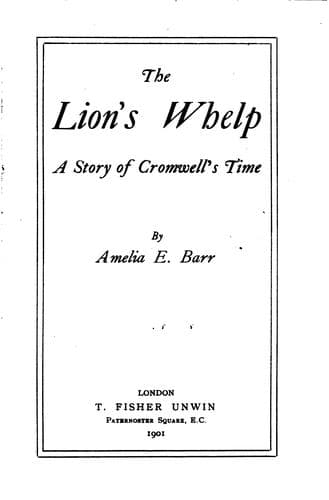
The Lion's Whelp: A Story of Cromwell's TimeBarr, Amelia E.
History
The Lion's Whelp: A Story of Cromwell's Time
Barr, Amelia E.
Great Britain -- History -- Stuarts, 1603-1714 -- Fiction
Jane heard constantly of these events, but her heart had closer
interests. The ship which was to carry Cluny and herself to America was
lying at her wharf nearly ready for sea. It was a stout vessel
belonging to Sir Thomas Jevery, commanded by a captain of tried skill
and great piety. There were to be no other passengers; Cluny and Jane
alone were to find in its black-ribbed cabin their home for many weeks,
perhaps months. A recent experience had proven the necessity for this
exclusion of strange elements. Early in June, Israel had taken Cluny to
bid farewell to his old General, and the meeting had tried both men
severely. A few days previous, Cromwell had laid in the grave his
little grandson, Oliver, and the child’s image still lived in his
troubled eyes. He could scarcely speak when he saw Cluny. He waived
impatiently all ceremony, drew him to his breast and kissed him; but it
was quickly evident Cluny could not bear any conversation on his past
misery. His excitement became painful to witness, and Cromwell with
quick, kind wisdom, began to speak rather of his own great sorrow.
"You know, Israel," he said, "how sweet a little lad my Oliver was. I
cannot yet believe that he is dead; I cannot. Only a week ago, when he
was ill and restless, I lifted him and carried him to and fro, and his
cheek was against my cheek, and his arms around my neck, and suddenly I
felt them slip away, and I looked at the child, and so caught his last
smile. I thought that night my heart would break; but the consolations
of God are not small, and I shall go to the boy, though he will never
come back to me. Never! Never! His mother is now very ill; you would
pity her, indeed you would. Cluny, you remember the Lady Elizabeth
Claypole?"
"My General, I shall never forget her."
"I do fear she is sick unto death. Her little Oliver’s removal has been
the last blow of the last enemy. You may pity me, Cluny; I need pity, I
do indeed; I am a man of many afflictions. But it is the Lord; let Him
do whatever seemeth good in His sight." He then went to a desk and
wrote a few lines to the officials of the Massachusetts Colony; in them,
commending Lord Neville to their kindness and care. His hands
trembled—those large strong hands—trembled as he gave the letter to
Cluny. Then he kissed him once more, and with a "Farewell" that was a
blessing, he turned away, weeping.
"It is another friend gone," he said mournfully to his own heart; "lover
and friend are put far from me and mine acquaintance into darkness."
But he went straight to his daughter Elizabeth, and talked to her only
of God’s great love and goodness, and of the dear boy who had been taken
from them because "he pleased God; because he was beloved of God, so
that living among sinners he was translated; yea, speedily was he taken
away, lest wickedness should alter his understanding or deceit beguile
his soul; and being made perfect in a short time, fulfilled a long
time."[1]
Public-domain text, read in full here on John Shaqi.
Reviews
Reviews
No reviews yet
Be the first to share your thoughts on this work.
Elsewhere in the archive
Join the Discussion
Join the discussion
Sign in to leave a comment or review.
Sign InorCreate an account