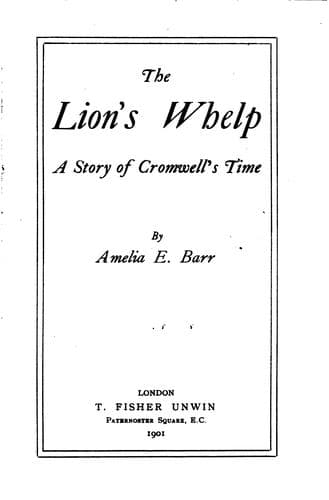
The Lion's Whelp: A Story of Cromwell's TimeBarr, Amelia E.
History
The Lion's Whelp: A Story of Cromwell's Time
Barr, Amelia E.
Great Britain -- History -- Stuarts, 1603-1714 -- Fiction
"And now," he continued, "I have a few words for you, women. In times
when everything seems on the perish, a deal depends on you. God knows
there are troubles enough for us all, but some women are never weary of
hunting for more. It is a poor business. Give it up. You know that
you often make wretched days for yourselves, and every one you come
across, about little things not worth minding. I have heard men that
have been in tropic countries say ’they hardly ever saw the lions and
serpents they feared,’ but that the flies and the insects and the heat
made their lives miserable enough. That is the way in most women’s
lives; they hear about sieges and battles and awful death, but such
things don’t often come to their door-step. If they do, my experience
is that women behave themselves nobly; they lift up their hearts and
meet their fate like men and Christians.
"I am bound to say, the main part of women’s troubles comes from little
things—from very little things. I’ve known a broken pitcher, or a slice
of burned bread, or a smoky fire do the black business for a whole day.
No matter what comes, women, keep a cheerful temper. Cheerfulness is the
very coin of happiness. The devil loves a woman with a snappy, nagging
temper; she does lots of business for him, without his helping her. I
don’t think any of you here will take his arles-penny, or work for his
’well done.’ Besides, all women want to be loved; but I can tell you,
every one feels bitter and hard to those _who prevent happiness_. It is
easier to forgive a person for doing us a great wrong than for
deliberately spoiling our comfort because some trifling thing has put
them out. A woman who will do that is a selfish creature, and she ought
to live by herself."
The short service was followed by an excellent dinner, and the richly
dressed men and women, full of eager questions and innocent mirth,
filled the Swaffham parlours, and made a fair picture of hospitality
sobered by great interests and great events. Some of the guests
lingered for two and three days, but Dr. Verity would not be delayed.
The next morning he enrolled sixty men, and then he was resolved to ride
with them as far as York. "And if Neville comes, send him quickly after
me," he said. "He thought he might be four days, but I will give him
seven, and then wonder if he keeps tryst. There will be many things in
London to delay him."
In fact Neville was so long delayed, that Mrs. Swaffham was certain he
had been sent back to Scotland at once on Mrs. Cromwell’s order, and
that he would probably be with the Lord General before Dr. Verity.
After a week or more had passed, all expectation of his visit died out,
and Jane began to wonder why Matilda had not been to see her.
Public-domain text, read in full here on John Shaqi.
Reviews
Reviews
No reviews yet
Be the first to share your thoughts on this work.
Join the Discussion
Join the discussion
Sign in to leave a comment or review.
Sign InorCreate an account